Islam gets a bad rap sometimes.
This is understandable in a world with Al Qaeda and ISIS, but not everyone is in these organizations. In fact, these kinds of terrorist organizations comprise the tiniest minority of Muslims.
At the same time, it's not correct to say that members of ISIS aren't Muslim. They're actually very strict in reading the Koran and following it. Indeed, their very problem, it might be said (at least if this article, which is a very interesting and insightful, though long, read, is to be believed), is that they are too strict and literal in their reading and interpretation of many aspects of Islamic scripture, and they fail to recognize that they're doing any interpretation at all. This same article gives an example of a very peaceful, quiet branch of Islam that is just as strict in its interpretation of the Koran, which views ISIS as neglecting some of the most important aspects of Islam (particularly unity of the umma, or Muslim community) in favor of the particulars they focus on so heavily.
So Islam is (as so many have been proclaiming the last several years) a religion of peace, yet, apparently, it can give rise to atrocities. How can this be?
Well, the same way that Christianity could give rise to the Inquisition.
I'm not a scholar of Islam, so I can't say whether the analogy is perfect, but you have to realize that any written word is subject to interpretation. Of course, some things are clearer than others, but even such definitive statements as "Thou shalt not kill" are complicated a bit by translation (some have suggested that it should really be translated "murder" rather than "kill," and then you can get into shades of meaning and things), and anyway the Children of Israel were elsewhere commanded to go to war. So if you really want, you can play interpretation games even with things that seem relatively clear.
In the case of the Inquisition, it seems pretty clear to me that there's some pretty bad interpretation going on, possibly colored more by aspirations for power than by sincere searching for truth. There's really no sign in the Bible of the Lord approving of torture, and it seems pretty clear to me that the response of the Church to sin that is approved of by Christ's teachings and the writings of the apostles doesn't include torture and killing. In 3 John, we hear about a branch of the Church that seems to be falling apart, with unquestionable apostates (they won't even allow the apostles to come speak to them), yet there's no sign that John was planning to inflict any physical punishment on these people.
Still, Christ did say that he "came not to bring peace, but a sword." So maybe Crusades and Inquisitions make sense? Never mind that this is a single verse, and that the context is His saying that His followers must choose to follow Him even if it causes division. Never mind that He further explains this concept, that even families might be divided for the sake of the Gospel, and set against each other. Clearly the only valid interpretation is that we must take up arms against unbelievers. Actually, you might be able to make some kind of a case for that interpretation, but it seems rather thin to me, especially in light of Christ's response to Peter coming to His defense (if you're not familiar, Peter cut the ear off a servant in the crowd that came to arrest Jesus, and Jesus healed the man). Still, you could make the case.
So Christianity is a religion of peace, one centered on the Prince of Peace, yet in His name some rather horrible things have been done. It just requires a bit of creative interpretation.
Now, lest the secularists in the audience claim that this is the fault of religion, I'd like to point out one more good thing which has been used to justify terrible things. You see, both the Nazis and the Soviet Union called their regimes the first "scientific" systems of government. They acted in the name of science. Sure, it required some pretty horrible interpretations and misunderstandings to get from real science to Soviet policies, but still, if you're going to hold the interpretations that a minority assigns to a religion against the whole religion, you'll have to do the same thing with science.
In short, whether you believe in Christianity, Islam, or nothing beyond science, someone has used what you believe in as a justification to do something terrible. So be charitable in judging others' beliefs.
Showing posts with label Religion. Show all posts
Showing posts with label Religion. Show all posts
Sunday, February 22, 2015

Friday, December 21, 2012
"My yoke is easy and my burden is light"
Come unto me, all ye that labour and are heavy laden, and I will give you rest. Take my yoke upon you, and learn of me; for I am meek and lowly of heart: and ye shall find rest unto your souls. For my yoke is easy, and my burden is light. -Matthew 11:28-30
The Lord taught me something new about this beautiful passage recently, something I thought worth sharing.
Think about a yoke. What does it do? What is it for? A yoke is a device used to connect two draft animals, such as oxen. It is a frame that goes around their necks so that a load can be pulled on their shoulders. It is a device, in short, to get animals to do work, to allow greater loads to be pulled by them.
Seen this way, it seems odd to say that taking His yoke upon us will help us find rest. Taking His yoke upon us is submitting to work and to trial. Indeed, taking His yoke upon us is submitting to commandments and covenants, committing to service and work. It's anything but laziness.
Yet that's not understanding the whole purpose of a yoke. A yoke gets animals to do work, but does so by combining the efforts of two of them. So when we take Christ's yoke upon us, we are committing to work, but we're also combining our efforts with the being with which we are yoked: Christ Himself. So we are adding to our load in one sense, adding callings and tithing and the commandment to forgive to all of our other challenges, but at the same time, Christ is suddenly helping us with our load.
To this He adds, "My yoke is easy and my burden is light." And it is. Compared to the baggage we bring to this wagon team, His burden is very light indeed. And He is, in the language of this analogy, the strongest ox we could possibly be paired with. Yes, He brings an additional load, but then He does almost all the work on both His and ours, all He asks is our best effort.
The Gospel is work, but the Lord is doing the heavy lifting. Don't worry about whether you have the strength to commit to do His will, because you'll find that He provides it.
The Lord taught me something new about this beautiful passage recently, something I thought worth sharing.
Think about a yoke. What does it do? What is it for? A yoke is a device used to connect two draft animals, such as oxen. It is a frame that goes around their necks so that a load can be pulled on their shoulders. It is a device, in short, to get animals to do work, to allow greater loads to be pulled by them.
Seen this way, it seems odd to say that taking His yoke upon us will help us find rest. Taking His yoke upon us is submitting to work and to trial. Indeed, taking His yoke upon us is submitting to commandments and covenants, committing to service and work. It's anything but laziness.
Yet that's not understanding the whole purpose of a yoke. A yoke gets animals to do work, but does so by combining the efforts of two of them. So when we take Christ's yoke upon us, we are committing to work, but we're also combining our efforts with the being with which we are yoked: Christ Himself. So we are adding to our load in one sense, adding callings and tithing and the commandment to forgive to all of our other challenges, but at the same time, Christ is suddenly helping us with our load.
To this He adds, "My yoke is easy and my burden is light." And it is. Compared to the baggage we bring to this wagon team, His burden is very light indeed. And He is, in the language of this analogy, the strongest ox we could possibly be paired with. Yes, He brings an additional load, but then He does almost all the work on both His and ours, all He asks is our best effort.
The Gospel is work, but the Lord is doing the heavy lifting. Don't worry about whether you have the strength to commit to do His will, because you'll find that He provides it.
Monday, October 1, 2012
I'm Trying to Be Like Jesus
Yesterday I posted about how excited I am for Conference, what that means, and how it's all tied to a central tenant of "Mormonism." A few months ago I posted a testimony that I still feel shows the beauty of the Gospel and its simplest tenants. But after yesterday's post, I thought of another way, a very beautiful way that the real essence of the Gospel is taught. There is a song for children, and it may be the most beautiful statement of what we're trying to do in the Church that exists:
I'm trying to be like Jesus.
I'm following in His ways.
I'm trying to love as He did
In all that I do and say.
At times I am tempted to make a wrong choice
But I try to listen as the still small voice whispers:
"Love one another as Jesus love you.
Try to show kindness in all that you do.
Be gentle and loving in deed and in thought,
For these are the things Jesus taught."
I'm trying to love my neighbor.
I'm trying to serve my friend.
I watch for the day of gladness
When Jesus will come again.
I try to remember the lessons He taught
Then the Holy Spirit enters into my thoughts saying:
"Love one another as Jesus love you.
Try to show kindness in all that you do.
Be gentle and loving in deed and in thought,
For these are the things Jesus taught."
I suggest listening to it, performed by a wonderful choir in its beautiful simplicity.
I'm trying to be like Jesus.
I'm following in His ways.
I'm trying to love as He did
In all that I do and say.
At times I am tempted to make a wrong choice
But I try to listen as the still small voice whispers:
"Love one another as Jesus love you.
Try to show kindness in all that you do.
Be gentle and loving in deed and in thought,
For these are the things Jesus taught."
I'm trying to love my neighbor.
I'm trying to serve my friend.
I watch for the day of gladness
When Jesus will come again.
I try to remember the lessons He taught
Then the Holy Spirit enters into my thoughts saying:
"Love one another as Jesus love you.
Try to show kindness in all that you do.
Be gentle and loving in deed and in thought,
For these are the things Jesus taught."
I suggest listening to it, performed by a wonderful choir in its beautiful simplicity.
Sunday, September 30, 2012
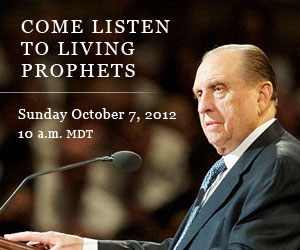
Come Listen to a Prophet's Voice
This post will be a bit of a break from what I've been doing. Rather than going into deep detail in discussing principles and reasoning through my philosophy on different subjects, this post is the result of something extremely exciting: General Conference. The Mormons in the audience know what I'm talking about, but for any who read this that aren't members of the Church of Jesus Christ of Latter-Day Saints, allow me to explain.
A central tenant of the Church's teachings is that there is a living prophet on the earth today. The President of the Church, Thomas S. Monson, is a prophet as much as Moses or Abraham or Elijah (and quite possibly the nicest man alive... stories include serving dozens of widows for years, comforting a mother whose son had died in battle as a young teenager, and abandoning his prepared remarks for an address broadcast worldwide in response to a revelation to help a girl he'd never met, but saw in the live audience), and he has two counselors who are just about as good and warm and kind-hearted, and there are twelve apostles, all similarly wonderful models. All fifteen of these men are called and ordained to be "prophets, seers, and revelators," to receive revelation, communication directly from God, for the whole world.
Every six months, fifteen men who are among the best and kindest that the world has to offer, and among the closest to God, as well as other wonderful men and women, speak to the world, everyone who will listen. Not only that, they're saying what God wants them to say.
As someone who knows by a personal revelation from God Himself that this is what is actually taking place, you can probably understand my thinking that this is awesome. We are told the things that we most need to know in order to survive and thrive in the next six months. And they're prophets. The things they say have predictive power. You find solutions to problems by listening to them, even problems that you don't know you have yet (for example, "get out of debt" was part of their refrain in the years leading up to the most recent recession). On top of that, it's a recharge, you're riding the high for days after conference lets out.
But even beside all of that, this awesome semi-annual event is something of a holiday in Mormon culture. The reasons for this include exactly what I've said above, but some other things. For example, most people watch conference in their own homes on the internet. The natural effect of this is that you go to church in your pajamas, which is exciting in and of itself. When you're not listening to awesome thoughts from awesome people to make your life awesome in your own home, you might get together with some friends and have a conference party. When I was in Utah, at BYU, for my undergraduate, we would typically go up to visit my aunt and uncle in Layton for the Sunday sessions ("we" meaning myself and several of my cousins). Last conference, in April, we got a huge group together over at someone's apartment and had homemade pizza and ice cream. Next week I'll probably get together with a smaller group of friends and have another party.
Yes, that's right, I don't think I've mentioned that so far. It's next week.
This time next week, I'll just be listening to the tail end of men and women sent by God speaking to the world and saying what God wants said to the world. And it will be awesome.
Anyone who wants a spiritual and emotional high? Watch General Conference. Anyone who wants answers to deep spiritual questions? Watch General Conference. Anyone who wants answers to practical questions and problems that they are facing now and will face over the next six months? Watch General Conference. Anyone who wants to understand what the Church of Jesus Christ of Latter-Day Saints really believes? Watch General Conference. Anyone who wants to understand us, be it only out of curiosity? Watch General Conference, all or part of it, next Saturday and Sunday. I promise you as I can promise about few things: it will be worth your while, and if you go into it with the right attitude, it will be even better than that.
Watch here:
http://www.lds.org/general-conference?lang=eng
October 6 & 7, 10 AM-12 PM and 2PM-4PM Mountain Daylight Time (16-18 & 20-22 UTC), or talk to any Mormon friends you may have, I'm sure they'd be happy to invite you to a conference party, or feel free to comment or e-mail me for any additional information. And if you happen to live close to Chicago, IL, this is your invitation to join me for a conference party. Come join me, not only will it be pure awesomeness, but it's an opportunity like no other to see Mormons in their natural environment!
Excited? That's an understatement.
Title: Hymns of the Church of Jesus Christ of Latter-Day Saints, No. 21
A central tenant of the Church's teachings is that there is a living prophet on the earth today. The President of the Church, Thomas S. Monson, is a prophet as much as Moses or Abraham or Elijah (and quite possibly the nicest man alive... stories include serving dozens of widows for years, comforting a mother whose son had died in battle as a young teenager, and abandoning his prepared remarks for an address broadcast worldwide in response to a revelation to help a girl he'd never met, but saw in the live audience), and he has two counselors who are just about as good and warm and kind-hearted, and there are twelve apostles, all similarly wonderful models. All fifteen of these men are called and ordained to be "prophets, seers, and revelators," to receive revelation, communication directly from God, for the whole world.
Every six months, fifteen men who are among the best and kindest that the world has to offer, and among the closest to God, as well as other wonderful men and women, speak to the world, everyone who will listen. Not only that, they're saying what God wants them to say.
As someone who knows by a personal revelation from God Himself that this is what is actually taking place, you can probably understand my thinking that this is awesome. We are told the things that we most need to know in order to survive and thrive in the next six months. And they're prophets. The things they say have predictive power. You find solutions to problems by listening to them, even problems that you don't know you have yet (for example, "get out of debt" was part of their refrain in the years leading up to the most recent recession). On top of that, it's a recharge, you're riding the high for days after conference lets out.
But even beside all of that, this awesome semi-annual event is something of a holiday in Mormon culture. The reasons for this include exactly what I've said above, but some other things. For example, most people watch conference in their own homes on the internet. The natural effect of this is that you go to church in your pajamas, which is exciting in and of itself. When you're not listening to awesome thoughts from awesome people to make your life awesome in your own home, you might get together with some friends and have a conference party. When I was in Utah, at BYU, for my undergraduate, we would typically go up to visit my aunt and uncle in Layton for the Sunday sessions ("we" meaning myself and several of my cousins). Last conference, in April, we got a huge group together over at someone's apartment and had homemade pizza and ice cream. Next week I'll probably get together with a smaller group of friends and have another party.
Yes, that's right, I don't think I've mentioned that so far. It's next week.
This time next week, I'll just be listening to the tail end of men and women sent by God speaking to the world and saying what God wants said to the world. And it will be awesome.
Anyone who wants a spiritual and emotional high? Watch General Conference. Anyone who wants answers to deep spiritual questions? Watch General Conference. Anyone who wants answers to practical questions and problems that they are facing now and will face over the next six months? Watch General Conference. Anyone who wants to understand what the Church of Jesus Christ of Latter-Day Saints really believes? Watch General Conference. Anyone who wants to understand us, be it only out of curiosity? Watch General Conference, all or part of it, next Saturday and Sunday. I promise you as I can promise about few things: it will be worth your while, and if you go into it with the right attitude, it will be even better than that.
Watch here:
http://www.lds.org/general-conference?lang=eng
October 6 & 7, 10 AM-12 PM and 2PM-4PM Mountain Daylight Time (16-18 & 20-22 UTC), or talk to any Mormon friends you may have, I'm sure they'd be happy to invite you to a conference party, or feel free to comment or e-mail me for any additional information. And if you happen to live close to Chicago, IL, this is your invitation to join me for a conference party. Come join me, not only will it be pure awesomeness, but it's an opportunity like no other to see Mormons in their natural environment!
Excited? That's an understatement.
Title: Hymns of the Church of Jesus Christ of Latter-Day Saints, No. 21
Wednesday, June 15, 2011
Irreligion as the state religion would be the worst of all combinations
Presupposing that at least some, such as myself, view religious conviction as an important source of morality, and morality being a basis for popular sovereignty within my (and, I presume, some others') political philosophy, and considering the controversy of the subject, it may be natural to address the role of religion in public discourse at this point.
First, let me state what I believe to be a significant problem: In many circles, a religious conviction is viewed as illegitimate, an unsound basis for belief, and those subscribing to such convictions are even, at times, viewed as diminished by those views (recall my first post, in which I cited the allegation that a person couldn't be a good scientist and religious). In many circles, a person acting from religious conviction in the public sphere is viewed as improper, and it's even argued that such actions are contrary to the establishment clause in the First Amendment of the US Constitution.
I would like to go on the record as saying that such a view of religious conviction is not only incorrect, but inconsistent.
First of all, there is the problem that Elder Maxwell noted way back in 1978, that such an approach actually establishes irreligion as a preferred religion. All opinions must be placed on irreligious terms if action from religious conviction is considered illegitimate.
Second, under such a view, one must appeal to a philosophical axiom which is just as scientifically unprovable as a religious conviction. Science only makes measurement of what is, and if what is differs from what ought to be, then science can know nothing of it, having no way of measuring what ought to be independent of what is. Thus, science can discover nothing of the basic axioms of Ethics. Similarly, Mathematics is based on an axiomatic structure: you must assume something before you can build anything up. Logic requires basic facts to make conclusions. In short, the methods by which there is any certainty in a secular world can say nothing of the most basic principles of Ethics. One requires certain unprovable definitions and axioms in order to assert anything contrary to Moral Realism and the ability to gain moral truth from a divine source. We are now bound to return to a question very similar to the old one; now it is, "Under what philosophical set of axioms should we act?" My answer is to let everyone act on the philosophical ground that they see fit in public discourse, for there is no objective and independent way of determining which world views have validity and which do not. Yet dismissing or barring religion from public discourse arbitrarily decides what, out of all these possibilities, is right.
And what of people in public office? The same applies. Supposing that I were to run for public office, then my philosophical and moral beliefs would be quite visible. If the people wish to elect a Moral Realist with certain beliefs about moral truth, who will scrupulously attempt to balance their wishes with his morality (generally siding with them, but perhaps breaking with the majority at times), and who will seek to serve them, then why shouldn't I, religious beliefs and all, be allowed to serve? In fact, even if I weren't to make such efforts to balance popular opinion with my beliefs, even if I were to completely ignore my constituency and simply vote based on what I think, so long as the people knowingly and willingly chose my moral sense rather than a willingness to cater to their opinion, could they not do so (now, I do believe that I would feel a need to regard the opinion of my constituency, yet the argument stands, so far as I can see)? If the people see me as fit, see my moral code as good, and believe me to be wise, then my actions should not be viewed as anything less than legitimate. If they want the wisest, most honest, and most moral person that they can find, rather than one selected by any number of other criteria (such as choosing someone based on whether they will vote as they wish), and believe that I am him, then their choice for integrity, wisdom, and morality should be honored. It is only if I were to act dishonestly, to attempt to deceive the electorate, perhaps hiding my Moral Realism until I was in office, that actions based on that would not carry the full weight of legitimacy offered by the will of the people.
Now, two more points: First, this goes both ways. In a society built on liberty and popular sovereignty, everyone must be free to act on his philosophical and moral beliefs. An atheist and a Moral Relativist treating all of society as a social contract should be free to use his vote and his voice to put forward those parts of the contract which he sees as most to his benefit. A Moral Realist should be free to advocate whatever he believes to be right in the society, whatever his source for that belief.
Second, it is important to realize that there is at least one type of public discourse where all must be done from common philosophical ground: in a debate. For if there is not common ground in debate with regards to the pertinent axioms and material facts then a civil debate becomes extremely difficult, possibly meaningless. If the differences lie in things which cannot be successfully argued (such as basic axioms), then what can a debate tell us? Perhaps a reader can suggest a solution, but I, for one, do not see how a debate can be effective if those arguing do not share this kind of common ground. The best solution that I can see is for those involved to agree on the axioms under which they will be operating for the purpose of the debate beforehand, but honestly this, to me, indicates that modern political debates are unlikely to be effective... and I would assert that my observation confirms this.
Title: Neal A. Maxwell, Meeting the Challenges of Today
First, let me state what I believe to be a significant problem: In many circles, a religious conviction is viewed as illegitimate, an unsound basis for belief, and those subscribing to such convictions are even, at times, viewed as diminished by those views (recall my first post, in which I cited the allegation that a person couldn't be a good scientist and religious). In many circles, a person acting from religious conviction in the public sphere is viewed as improper, and it's even argued that such actions are contrary to the establishment clause in the First Amendment of the US Constitution.
I would like to go on the record as saying that such a view of religious conviction is not only incorrect, but inconsistent.
First of all, there is the problem that Elder Maxwell noted way back in 1978, that such an approach actually establishes irreligion as a preferred religion. All opinions must be placed on irreligious terms if action from religious conviction is considered illegitimate.
Second, under such a view, one must appeal to a philosophical axiom which is just as scientifically unprovable as a religious conviction. Science only makes measurement of what is, and if what is differs from what ought to be, then science can know nothing of it, having no way of measuring what ought to be independent of what is. Thus, science can discover nothing of the basic axioms of Ethics. Similarly, Mathematics is based on an axiomatic structure: you must assume something before you can build anything up. Logic requires basic facts to make conclusions. In short, the methods by which there is any certainty in a secular world can say nothing of the most basic principles of Ethics. One requires certain unprovable definitions and axioms in order to assert anything contrary to Moral Realism and the ability to gain moral truth from a divine source. We are now bound to return to a question very similar to the old one; now it is, "Under what philosophical set of axioms should we act?" My answer is to let everyone act on the philosophical ground that they see fit in public discourse, for there is no objective and independent way of determining which world views have validity and which do not. Yet dismissing or barring religion from public discourse arbitrarily decides what, out of all these possibilities, is right.
And what of people in public office? The same applies. Supposing that I were to run for public office, then my philosophical and moral beliefs would be quite visible. If the people wish to elect a Moral Realist with certain beliefs about moral truth, who will scrupulously attempt to balance their wishes with his morality (generally siding with them, but perhaps breaking with the majority at times), and who will seek to serve them, then why shouldn't I, religious beliefs and all, be allowed to serve? In fact, even if I weren't to make such efforts to balance popular opinion with my beliefs, even if I were to completely ignore my constituency and simply vote based on what I think, so long as the people knowingly and willingly chose my moral sense rather than a willingness to cater to their opinion, could they not do so (now, I do believe that I would feel a need to regard the opinion of my constituency, yet the argument stands, so far as I can see)? If the people see me as fit, see my moral code as good, and believe me to be wise, then my actions should not be viewed as anything less than legitimate. If they want the wisest, most honest, and most moral person that they can find, rather than one selected by any number of other criteria (such as choosing someone based on whether they will vote as they wish), and believe that I am him, then their choice for integrity, wisdom, and morality should be honored. It is only if I were to act dishonestly, to attempt to deceive the electorate, perhaps hiding my Moral Realism until I was in office, that actions based on that would not carry the full weight of legitimacy offered by the will of the people.
Now, two more points: First, this goes both ways. In a society built on liberty and popular sovereignty, everyone must be free to act on his philosophical and moral beliefs. An atheist and a Moral Relativist treating all of society as a social contract should be free to use his vote and his voice to put forward those parts of the contract which he sees as most to his benefit. A Moral Realist should be free to advocate whatever he believes to be right in the society, whatever his source for that belief.
Second, it is important to realize that there is at least one type of public discourse where all must be done from common philosophical ground: in a debate. For if there is not common ground in debate with regards to the pertinent axioms and material facts then a civil debate becomes extremely difficult, possibly meaningless. If the differences lie in things which cannot be successfully argued (such as basic axioms), then what can a debate tell us? Perhaps a reader can suggest a solution, but I, for one, do not see how a debate can be effective if those arguing do not share this kind of common ground. The best solution that I can see is for those involved to agree on the axioms under which they will be operating for the purpose of the debate beforehand, but honestly this, to me, indicates that modern political debates are unlikely to be effective... and I would assert that my observation confirms this.
Title: Neal A. Maxwell, Meeting the Challenges of Today
Subscribe to:
Posts (Atom)