Come unto me, all ye that labour and are heavy laden, and I will give you rest. Take my yoke upon you, and learn of me; for I am meek and lowly of heart: and ye shall find rest unto your souls. For my yoke is easy, and my burden is light. -Matthew 11:28-30
The Lord taught me something new about this beautiful passage recently, something I thought worth sharing.
Think about a yoke. What does it do? What is it for? A yoke is a device used to connect two draft animals, such as oxen. It is a frame that goes around their necks so that a load can be pulled on their shoulders. It is a device, in short, to get animals to do work, to allow greater loads to be pulled by them.
Seen this way, it seems odd to say that taking His yoke upon us will help us find rest. Taking His yoke upon us is submitting to work and to trial. Indeed, taking His yoke upon us is submitting to commandments and covenants, committing to service and work. It's anything but laziness.
Yet that's not understanding the whole purpose of a yoke. A yoke gets animals to do work, but does so by combining the efforts of two of them. So when we take Christ's yoke upon us, we are committing to work, but we're also combining our efforts with the being with which we are yoked: Christ Himself. So we are adding to our load in one sense, adding callings and tithing and the commandment to forgive to all of our other challenges, but at the same time, Christ is suddenly helping us with our load.
To this He adds, "My yoke is easy and my burden is light." And it is. Compared to the baggage we bring to this wagon team, His burden is very light indeed. And He is, in the language of this analogy, the strongest ox we could possibly be paired with. Yes, He brings an additional load, but then He does almost all the work on both His and ours, all He asks is our best effort.
The Gospel is work, but the Lord is doing the heavy lifting. Don't worry about whether you have the strength to commit to do His will, because you'll find that He provides it.
Friday, December 21, 2012

Sunday, October 21, 2012
They're so happy, they don't know how miserable they are.
I really like "Fiddler on the Roof." I especially love the character, Tevye. He's a simple, poor milkman who always wanted an education, and while he never got that, he has wit and discernment to see through the problems and the changing world around him to what is essential (and has a host of great one-liners on the way). If you haven't seen it, I highly recommend it, the movie is great. Also, minor spoiler alert: I'm going to tell you a little bit about the story below.
One great insight comes a few months after the marriage of his daughter, Tzeitel, to a poor man, Motel. Speaking of this young, poor couple Tevye says, "They work very hard, and they're as poor as squirrels in winter. But, they're so happy, they don't know how miserable they are."
I think there's a couple of lessons for us from Tevye and his daughter and son-in-law.
First off, there's something to be said for counting your blessings and being happy with where you are now. Motel and Tzeitel were very poor, but they were happy all the same. They just kept working hard, and it didn't matter that they were barely scraping by (if that). They were happy. Sometimes you can make a decision to see the blessings that you have now, and even beside your blessings, if you can't find any (let me assure you, though, they're there, you're always more blessed than you know), you can just choose to be happy. Put a smile on your face, laugh out loud, and be happy. I'm not saying it'll fix everything that's going wrong, but you are in control of your attitude, and it helps.
Second, take a chance on happiness even though you don't know the end. In the story, Motel, who was a tailor, originally hoped to save up enough money to buy a sewing machine before asking for Tzeitel's hand, in the hopes that he would be able to better provide for his family, because he would be able to do more and do a better job than working by hand. But in the end, he married Tzeitel before he could get a sewing machine, and as a result, they were as poor as his new father-in-law said. But they were as happy as Tevye observed, too.
The takeaway? Sometimes we wait to do things that will make us happy because of risk. The example from the movie is actually probably the most common one today. A lot of people are afraid to get married and have children until they're well on their way to their career, with perfect security for the future. They pass on being so happy that they don't even realize how miserable they are, and miss out on far better things than what they get, assuming they get anything at all out of waiting (studies seem about as conclusive as social sciences can be about married people tending to do better in other endeavors because of the loving support of a spouse). Wouldn't it be better to be so happy, you don't know how miserable you are?
One great insight comes a few months after the marriage of his daughter, Tzeitel, to a poor man, Motel. Speaking of this young, poor couple Tevye says, "They work very hard, and they're as poor as squirrels in winter. But, they're so happy, they don't know how miserable they are."
I think there's a couple of lessons for us from Tevye and his daughter and son-in-law.
First off, there's something to be said for counting your blessings and being happy with where you are now. Motel and Tzeitel were very poor, but they were happy all the same. They just kept working hard, and it didn't matter that they were barely scraping by (if that). They were happy. Sometimes you can make a decision to see the blessings that you have now, and even beside your blessings, if you can't find any (let me assure you, though, they're there, you're always more blessed than you know), you can just choose to be happy. Put a smile on your face, laugh out loud, and be happy. I'm not saying it'll fix everything that's going wrong, but you are in control of your attitude, and it helps.
Second, take a chance on happiness even though you don't know the end. In the story, Motel, who was a tailor, originally hoped to save up enough money to buy a sewing machine before asking for Tzeitel's hand, in the hopes that he would be able to better provide for his family, because he would be able to do more and do a better job than working by hand. But in the end, he married Tzeitel before he could get a sewing machine, and as a result, they were as poor as his new father-in-law said. But they were as happy as Tevye observed, too.
The takeaway? Sometimes we wait to do things that will make us happy because of risk. The example from the movie is actually probably the most common one today. A lot of people are afraid to get married and have children until they're well on their way to their career, with perfect security for the future. They pass on being so happy that they don't even realize how miserable they are, and miss out on far better things than what they get, assuming they get anything at all out of waiting (studies seem about as conclusive as social sciences can be about married people tending to do better in other endeavors because of the loving support of a spouse). Wouldn't it be better to be so happy, you don't know how miserable you are?
Monday, October 1, 2012
I'm Trying to Be Like Jesus
Yesterday I posted about how excited I am for Conference, what that means, and how it's all tied to a central tenant of "Mormonism." A few months ago I posted a testimony that I still feel shows the beauty of the Gospel and its simplest tenants. But after yesterday's post, I thought of another way, a very beautiful way that the real essence of the Gospel is taught. There is a song for children, and it may be the most beautiful statement of what we're trying to do in the Church that exists:
I'm trying to be like Jesus.
I'm following in His ways.
I'm trying to love as He did
In all that I do and say.
At times I am tempted to make a wrong choice
But I try to listen as the still small voice whispers:
"Love one another as Jesus love you.
Try to show kindness in all that you do.
Be gentle and loving in deed and in thought,
For these are the things Jesus taught."
I'm trying to love my neighbor.
I'm trying to serve my friend.
I watch for the day of gladness
When Jesus will come again.
I try to remember the lessons He taught
Then the Holy Spirit enters into my thoughts saying:
"Love one another as Jesus love you.
Try to show kindness in all that you do.
Be gentle and loving in deed and in thought,
For these are the things Jesus taught."
I suggest listening to it, performed by a wonderful choir in its beautiful simplicity.
I'm trying to be like Jesus.
I'm following in His ways.
I'm trying to love as He did
In all that I do and say.
At times I am tempted to make a wrong choice
But I try to listen as the still small voice whispers:
"Love one another as Jesus love you.
Try to show kindness in all that you do.
Be gentle and loving in deed and in thought,
For these are the things Jesus taught."
I'm trying to love my neighbor.
I'm trying to serve my friend.
I watch for the day of gladness
When Jesus will come again.
I try to remember the lessons He taught
Then the Holy Spirit enters into my thoughts saying:
"Love one another as Jesus love you.
Try to show kindness in all that you do.
Be gentle and loving in deed and in thought,
For these are the things Jesus taught."
I suggest listening to it, performed by a wonderful choir in its beautiful simplicity.
Sunday, September 30, 2012
Come Listen to a Prophet's Voice
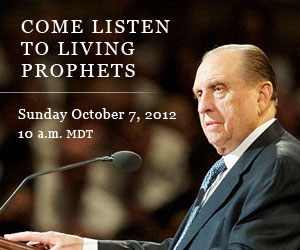
This post will be a bit of a break from what I've been doing. Rather than going into deep detail in discussing principles and reasoning through my philosophy on different subjects, this post is the result of something extremely exciting: General Conference. The Mormons in the audience know what I'm talking about, but for any who read this that aren't members of the Church of Jesus Christ of Latter-Day Saints, allow me to explain.
A central tenant of the Church's teachings is that there is a living prophet on the earth today. The President of the Church, Thomas S. Monson, is a prophet as much as Moses or Abraham or Elijah (and quite possibly the nicest man alive... stories include serving dozens of widows for years, comforting a mother whose son had died in battle as a young teenager, and abandoning his prepared remarks for an address broadcast worldwide in response to a revelation to help a girl he'd never met, but saw in the live audience), and he has two counselors who are just about as good and warm and kind-hearted, and there are twelve apostles, all similarly wonderful models. All fifteen of these men are called and ordained to be "prophets, seers, and revelators," to receive revelation, communication directly from God, for the whole world.
Every six months, fifteen men who are among the best and kindest that the world has to offer, and among the closest to God, as well as other wonderful men and women, speak to the world, everyone who will listen. Not only that, they're saying what God wants them to say.
As someone who knows by a personal revelation from God Himself that this is what is actually taking place, you can probably understand my thinking that this is awesome. We are told the things that we most need to know in order to survive and thrive in the next six months. And they're prophets. The things they say have predictive power. You find solutions to problems by listening to them, even problems that you don't know you have yet (for example, "get out of debt" was part of their refrain in the years leading up to the most recent recession). On top of that, it's a recharge, you're riding the high for days after conference lets out.
But even beside all of that, this awesome semi-annual event is something of a holiday in Mormon culture. The reasons for this include exactly what I've said above, but some other things. For example, most people watch conference in their own homes on the internet. The natural effect of this is that you go to church in your pajamas, which is exciting in and of itself. When you're not listening to awesome thoughts from awesome people to make your life awesome in your own home, you might get together with some friends and have a conference party. When I was in Utah, at BYU, for my undergraduate, we would typically go up to visit my aunt and uncle in Layton for the Sunday sessions ("we" meaning myself and several of my cousins). Last conference, in April, we got a huge group together over at someone's apartment and had homemade pizza and ice cream. Next week I'll probably get together with a smaller group of friends and have another party.
Yes, that's right, I don't think I've mentioned that so far. It's next week.
This time next week, I'll just be listening to the tail end of men and women sent by God speaking to the world and saying what God wants said to the world. And it will be awesome.
Anyone who wants a spiritual and emotional high? Watch General Conference. Anyone who wants answers to deep spiritual questions? Watch General Conference. Anyone who wants answers to practical questions and problems that they are facing now and will face over the next six months? Watch General Conference. Anyone who wants to understand what the Church of Jesus Christ of Latter-Day Saints really believes? Watch General Conference. Anyone who wants to understand us, be it only out of curiosity? Watch General Conference, all or part of it, next Saturday and Sunday. I promise you as I can promise about few things: it will be worth your while, and if you go into it with the right attitude, it will be even better than that.
Watch here:
http://www.lds.org/general-conference?lang=eng
October 6 & 7, 10 AM-12 PM and 2PM-4PM Mountain Daylight Time (16-18 & 20-22 UTC), or talk to any Mormon friends you may have, I'm sure they'd be happy to invite you to a conference party, or feel free to comment or e-mail me for any additional information. And if you happen to live close to Chicago, IL, this is your invitation to join me for a conference party. Come join me, not only will it be pure awesomeness, but it's an opportunity like no other to see Mormons in their natural environment!
Excited? That's an understatement.
Title: Hymns of the Church of Jesus Christ of Latter-Day Saints, No. 21
A central tenant of the Church's teachings is that there is a living prophet on the earth today. The President of the Church, Thomas S. Monson, is a prophet as much as Moses or Abraham or Elijah (and quite possibly the nicest man alive... stories include serving dozens of widows for years, comforting a mother whose son had died in battle as a young teenager, and abandoning his prepared remarks for an address broadcast worldwide in response to a revelation to help a girl he'd never met, but saw in the live audience), and he has two counselors who are just about as good and warm and kind-hearted, and there are twelve apostles, all similarly wonderful models. All fifteen of these men are called and ordained to be "prophets, seers, and revelators," to receive revelation, communication directly from God, for the whole world.
Every six months, fifteen men who are among the best and kindest that the world has to offer, and among the closest to God, as well as other wonderful men and women, speak to the world, everyone who will listen. Not only that, they're saying what God wants them to say.
As someone who knows by a personal revelation from God Himself that this is what is actually taking place, you can probably understand my thinking that this is awesome. We are told the things that we most need to know in order to survive and thrive in the next six months. And they're prophets. The things they say have predictive power. You find solutions to problems by listening to them, even problems that you don't know you have yet (for example, "get out of debt" was part of their refrain in the years leading up to the most recent recession). On top of that, it's a recharge, you're riding the high for days after conference lets out.
But even beside all of that, this awesome semi-annual event is something of a holiday in Mormon culture. The reasons for this include exactly what I've said above, but some other things. For example, most people watch conference in their own homes on the internet. The natural effect of this is that you go to church in your pajamas, which is exciting in and of itself. When you're not listening to awesome thoughts from awesome people to make your life awesome in your own home, you might get together with some friends and have a conference party. When I was in Utah, at BYU, for my undergraduate, we would typically go up to visit my aunt and uncle in Layton for the Sunday sessions ("we" meaning myself and several of my cousins). Last conference, in April, we got a huge group together over at someone's apartment and had homemade pizza and ice cream. Next week I'll probably get together with a smaller group of friends and have another party.
Yes, that's right, I don't think I've mentioned that so far. It's next week.
This time next week, I'll just be listening to the tail end of men and women sent by God speaking to the world and saying what God wants said to the world. And it will be awesome.
Anyone who wants a spiritual and emotional high? Watch General Conference. Anyone who wants answers to deep spiritual questions? Watch General Conference. Anyone who wants answers to practical questions and problems that they are facing now and will face over the next six months? Watch General Conference. Anyone who wants to understand what the Church of Jesus Christ of Latter-Day Saints really believes? Watch General Conference. Anyone who wants to understand us, be it only out of curiosity? Watch General Conference, all or part of it, next Saturday and Sunday. I promise you as I can promise about few things: it will be worth your while, and if you go into it with the right attitude, it will be even better than that.
Watch here:
http://www.lds.org/general-conference?lang=eng
October 6 & 7, 10 AM-12 PM and 2PM-4PM Mountain Daylight Time (16-18 & 20-22 UTC), or talk to any Mormon friends you may have, I'm sure they'd be happy to invite you to a conference party, or feel free to comment or e-mail me for any additional information. And if you happen to live close to Chicago, IL, this is your invitation to join me for a conference party. Come join me, not only will it be pure awesomeness, but it's an opportunity like no other to see Mormons in their natural environment!
Excited? That's an understatement.
Title: Hymns of the Church of Jesus Christ of Latter-Day Saints, No. 21
Saturday, September 1, 2012
They that understand it, get it. They that don't, pay it.
Tonight I'd really like to talk about debt, deficits, and interest. I'd like to address some simple facts about it on both a personal and a political level.
Before anything else, I must say that at the heart of my feelings on the subject is a thought, distilled in a quote by J. Reuben Clark:
"Interest never sleeps nor sickens nor dies; it never goes to the hospital; it works on Sundays and holidays; it never takes a vacation; it never visits nor travels; it takes no pleasure; it is never laid off work nor discharged from employment; it never works on reduced hours...; it has no love, no sympathy; it is as hard and soulless as a granite cliff. Once in debt, interest is your companion every minute of the day and night; you cannot shun it or slip away from it; you cannot dismiss it; it yields neither to entreaties, demands, or orders; and whenever you get in its way or cross its course or fail to meet its demands, it crushes you" (Conference Report, April 1938, pg. 103).
With this in mind, we need to make two important distinctions about debt. Debt itself is never good. If debt is ever worthwhile, it is not that the debt itself is good, but that it purchases things that are worth even such a terrible burden. If anything is good, it is the budget deficit which you have, the acquisition of debt, by which you acquire something of greater worth to you. Debt, once you have it, is merely a liability. You may argue that this is splitting hairs, that all debt was once a deficit, that all debt was useful in the moment of its creation, but it is important to remember that the debt itself is bad, especially as you consider the interest that comes with it. Anyway, this distinction between debt and deficit will be essential to further discussion.
The second distinction is that I wish to categorize deficits, specifically into two categories. There is what I will call a structural deficit, one which is part of the very structure of how things operate, and which is, in a sense, permanent. It is a deficit which is just there, which we do not have a plan for eliminating, which we anticipate being a part of the budget essentially forever. There is also what I will call a temporary deficit. It is something that is not structural, which is a deficit for some relatively brief period of time, after which either the budget is essentially balanced or there is a surplus to pay down the debt.
The J. Reuben Clark quote tells almost the whole story of interest and debt on a personal level. There are a few details to add. While this fact about interest makes it clear that living on credit is a foolish thing (personal finance with a structural deficit is impossible), one which will cause more grief than it's worth in the end, this does not say that all deficits are bad. The simplest counterexample to saying so is a mortgage. When you pay rent, all that money is gone forever, it does nothing for you except get you through another month. A mortgage payment includes interest and tax (which are gone forever when you pay them) and payment on principle, equity. Eventually, you own the house free and clear, and the only money that you throw away each month is property tax, far less than rent for an apartment or house. This fact can make a mortgage a wise thing. Of course, this doesn't justify more than a modest home, a large one bought on credit ends up being only a financial burden. Similarly, debt for education which vastly increases your long-term earnings can pay for itself within a few years. But then, if you get $100,000 in debt for an art degree, you may never see the additional earnings you need to make it financially wise. My point is that exceptions exist to the rule that deficits are bad (which is a good rule of thumb), but you must be very careful about it. Don't go into debt for that new car, instead wait a little longer with your old one and then buy a used one, it will get you from place to place just as well. Don't go into debt for furniture, you can live just fine with folding chairs and a card table (or, if you don't even have the money for those, sit on the floor) until you have the money to pay cash for the living room set. Only your pride will be hurt. And, no matter what, never go into debt without thinking about the quote above, or a similar sentiment, and being 100% sure that what you are buying on credit justifies itself so well that you're willing to enslave yourself (for debt is bondage) to a monster that will crush you if you do not obey it completely. I will never go into debt without thinking hard about it for days first.
That is the essence of my view on debt in personal finance: no structural deficits, and be very, very careful even of debt resulting from temporary ones. Any other plan will result in grief.
The first thing for considering debt on a large scale is the same: Whether it is a person or a nation, interest never sleeps. Yet people insist that debt is more complicated for a nation than a person, and a nation can exist with perpetual debt, never repaid. Because of this argument, let's break it down a little more.
A temporary deficit is defensible in the same way for a nation as it is for a person. Of course you need to be careful that the debt you will have afterward is worth your while, but there are exceptions to the rule that all deficits are bad. If someone is about to invade, it may be prudent to go into debt to fund a defensive effort, as the alternative may be even more costly. If technology produces something which will require a high-cost infrastructure upgrade, the investment may pay for itself in years to come. These things must be carefully evaluated in much the same way that buying a home or student loans must be.
But when a deficit becomes structural, we have to look at things a little bit differently. Here we can use some math to make some predictions.
In a country, we can always take the deficit as a fraction of GDP, and doing so yields some very interesting results for a structural deficit. For example, if we have a structural deficit of 3% of the GDP and a GDP growth rate of 3%, that means that the debt is growing at the same rate as the GDP. If this continues indefinitely, this relationship will override all initial conditions, so that the national debt will asymptotically approach the same value as the GDP: you'll asymptotically approach a debt to GDP ratio of 100%. Similarly, if the deficit is 6% and the GDP is 3%, you add twice as many dollars to the debt as you do to the GDP each year, and eventually you'll approach a debt to GDP ratio of 200%. In short, your debt to GDP ratio will asymptotically approach your deficit (as a fraction of GDP) to GDP growth rate ratio. This is significant as the debt to GDP ratio is a fair estimate of the debt burden on the country (if you have a larger economy, you can handle more debt).
Now let's add interest to the mix and consider two different scenarios. Let's say that the interest rate that the country pays on debt is 3%, and its GDP growth rate is 3%. Our two scenarios are that the country has no structural deficit, and that it has a 6% structural deficit, and that this has been going on for a long time (we've reached the no debt limit in one case, and the 200% debt to GDP ratio in the other). For the country with debt, you pay 3% of the debt in interest every year, which works out to 6% of the GDP. The country with no debt, of course, pays nothing. Notice anything interesting? The interest paid is the same as the deficit: the whole deficit ends up going to paying interest. This means that there is nothing left of the deficit to pay for extra government programs or service: the deficit buys nothing, it just maintains the debt. Therefore, the country with no debt can have the same government programs and taxes as the one with a large deficit.
I chose nice round numbers for this first example, but work it out with different numbers, and you'll find that the essential relationship is between the interest rate paid by the country and its GDP growth rate. If the interest rate is less than the growth rate, then a structural deficit stabilizing to a debt to GDP ratio will still yield some benefit to the country in terms of the programs that it can pay for. If, in my example, the interest rate had been 2% instead of 3%, it would have worked out that the country with debt had an extra 2% of GDP to use for programs out of its deficit. On the other hand, if the interest rate is higher than the growth rate, the country without a deficit actually has more money to use for programs than the one operating with a deficit, in the long-term limit. If the interest rate were 4% instead of 3%, the country with a deficit would actually have 2% of GDP less for its programs, in spite of the fact that it's running a very large deficit.
All of this, of course, assumes that all of these rates are static, and they never are. Things are more difficult and complicated than this. But at the same time, we can certainly make a case for this analysis, as you can always find an average growth rate, an average interest rate, and an average deficit (geometric mean, if you please, at least for the first two).
The other disclaimer on this analysis is that it's all long-term. Certainly if both countries start from the same level of debt, the one running a 6% deficit has an extra 6% of GDP to spend on programs the first year, regardless of interest (as they both pay the same interest starting from the same level of debt). But then, if you have a program that is a part of the very structure of your country, you need it to run in the long-term, and so its effect on long-term debt dynamics is an essential part of the analysis, and if it causes you trouble in the long-term dynamics, I think your plan is bad. No program should be enacted or maintained as if in perpetuity which will be insolvent in the long-term.
A final piece to this analysis is that it runs the other way as well: if a country receives interest on savings greater than its GDP growth rate, in the long-term dynamics a country with a budget surplus will actually end up having more money for government programs than one with a balanced budget. That does not mean that in such a case a country should instantly cut all programs in order to start such savings, as the short-term does matter as well. But in such a case, any country would be wise to find at least some cuts to begin the process of building long-term savings.
Lastly, a comment, outside the scope of the mathematical analysis. I have considered only the ability of a country to provide funding for extra programs as a result of its long-term structural debt, and shown that for interest rates about the GDP growth rate, the only benefit of a deficit is lost and actually reversed in the long term. However, this is not the only factor. Government programs are not the only effect of government debt. If there is a recession or war, a government with large structural debt is less able to cope with it than one with little or no debt. In the case that the interest rate is low, it may still be better for the government to have a smaller or no deficit. This, of course, is open to debate. But if we anticipate that in the long term the average interest rate is higher than the average GDP growth rate, then I think it clear that we would be wise to operate with only temporary deficits.
And... a final note, poking around the internet as I was mostly through finishing this, I'm guessing that I picked up the term "structural debt" from something I read somewhere. Feel free to look it up, and you'll find that the term is somewhat related to what I've defined, but different, relating to the deficit that a government would run with the economy at its maximum output. If any actual economists read this, my use of a real term for something other than it normally is may be confusing, but I have defined the term as I use it above, so I hope that helps.
Title: Attributed to my grandfather, though I'm not sure if he was the origin. "It" refers to interest.
Before anything else, I must say that at the heart of my feelings on the subject is a thought, distilled in a quote by J. Reuben Clark:
"Interest never sleeps nor sickens nor dies; it never goes to the hospital; it works on Sundays and holidays; it never takes a vacation; it never visits nor travels; it takes no pleasure; it is never laid off work nor discharged from employment; it never works on reduced hours...; it has no love, no sympathy; it is as hard and soulless as a granite cliff. Once in debt, interest is your companion every minute of the day and night; you cannot shun it or slip away from it; you cannot dismiss it; it yields neither to entreaties, demands, or orders; and whenever you get in its way or cross its course or fail to meet its demands, it crushes you" (Conference Report, April 1938, pg. 103).
With this in mind, we need to make two important distinctions about debt. Debt itself is never good. If debt is ever worthwhile, it is not that the debt itself is good, but that it purchases things that are worth even such a terrible burden. If anything is good, it is the budget deficit which you have, the acquisition of debt, by which you acquire something of greater worth to you. Debt, once you have it, is merely a liability. You may argue that this is splitting hairs, that all debt was once a deficit, that all debt was useful in the moment of its creation, but it is important to remember that the debt itself is bad, especially as you consider the interest that comes with it. Anyway, this distinction between debt and deficit will be essential to further discussion.
The second distinction is that I wish to categorize deficits, specifically into two categories. There is what I will call a structural deficit, one which is part of the very structure of how things operate, and which is, in a sense, permanent. It is a deficit which is just there, which we do not have a plan for eliminating, which we anticipate being a part of the budget essentially forever. There is also what I will call a temporary deficit. It is something that is not structural, which is a deficit for some relatively brief period of time, after which either the budget is essentially balanced or there is a surplus to pay down the debt.
The J. Reuben Clark quote tells almost the whole story of interest and debt on a personal level. There are a few details to add. While this fact about interest makes it clear that living on credit is a foolish thing (personal finance with a structural deficit is impossible), one which will cause more grief than it's worth in the end, this does not say that all deficits are bad. The simplest counterexample to saying so is a mortgage. When you pay rent, all that money is gone forever, it does nothing for you except get you through another month. A mortgage payment includes interest and tax (which are gone forever when you pay them) and payment on principle, equity. Eventually, you own the house free and clear, and the only money that you throw away each month is property tax, far less than rent for an apartment or house. This fact can make a mortgage a wise thing. Of course, this doesn't justify more than a modest home, a large one bought on credit ends up being only a financial burden. Similarly, debt for education which vastly increases your long-term earnings can pay for itself within a few years. But then, if you get $100,000 in debt for an art degree, you may never see the additional earnings you need to make it financially wise. My point is that exceptions exist to the rule that deficits are bad (which is a good rule of thumb), but you must be very careful about it. Don't go into debt for that new car, instead wait a little longer with your old one and then buy a used one, it will get you from place to place just as well. Don't go into debt for furniture, you can live just fine with folding chairs and a card table (or, if you don't even have the money for those, sit on the floor) until you have the money to pay cash for the living room set. Only your pride will be hurt. And, no matter what, never go into debt without thinking about the quote above, or a similar sentiment, and being 100% sure that what you are buying on credit justifies itself so well that you're willing to enslave yourself (for debt is bondage) to a monster that will crush you if you do not obey it completely. I will never go into debt without thinking hard about it for days first.
That is the essence of my view on debt in personal finance: no structural deficits, and be very, very careful even of debt resulting from temporary ones. Any other plan will result in grief.
The first thing for considering debt on a large scale is the same: Whether it is a person or a nation, interest never sleeps. Yet people insist that debt is more complicated for a nation than a person, and a nation can exist with perpetual debt, never repaid. Because of this argument, let's break it down a little more.
A temporary deficit is defensible in the same way for a nation as it is for a person. Of course you need to be careful that the debt you will have afterward is worth your while, but there are exceptions to the rule that all deficits are bad. If someone is about to invade, it may be prudent to go into debt to fund a defensive effort, as the alternative may be even more costly. If technology produces something which will require a high-cost infrastructure upgrade, the investment may pay for itself in years to come. These things must be carefully evaluated in much the same way that buying a home or student loans must be.
But when a deficit becomes structural, we have to look at things a little bit differently. Here we can use some math to make some predictions.
In a country, we can always take the deficit as a fraction of GDP, and doing so yields some very interesting results for a structural deficit. For example, if we have a structural deficit of 3% of the GDP and a GDP growth rate of 3%, that means that the debt is growing at the same rate as the GDP. If this continues indefinitely, this relationship will override all initial conditions, so that the national debt will asymptotically approach the same value as the GDP: you'll asymptotically approach a debt to GDP ratio of 100%. Similarly, if the deficit is 6% and the GDP is 3%, you add twice as many dollars to the debt as you do to the GDP each year, and eventually you'll approach a debt to GDP ratio of 200%. In short, your debt to GDP ratio will asymptotically approach your deficit (as a fraction of GDP) to GDP growth rate ratio. This is significant as the debt to GDP ratio is a fair estimate of the debt burden on the country (if you have a larger economy, you can handle more debt).
Now let's add interest to the mix and consider two different scenarios. Let's say that the interest rate that the country pays on debt is 3%, and its GDP growth rate is 3%. Our two scenarios are that the country has no structural deficit, and that it has a 6% structural deficit, and that this has been going on for a long time (we've reached the no debt limit in one case, and the 200% debt to GDP ratio in the other). For the country with debt, you pay 3% of the debt in interest every year, which works out to 6% of the GDP. The country with no debt, of course, pays nothing. Notice anything interesting? The interest paid is the same as the deficit: the whole deficit ends up going to paying interest. This means that there is nothing left of the deficit to pay for extra government programs or service: the deficit buys nothing, it just maintains the debt. Therefore, the country with no debt can have the same government programs and taxes as the one with a large deficit.
I chose nice round numbers for this first example, but work it out with different numbers, and you'll find that the essential relationship is between the interest rate paid by the country and its GDP growth rate. If the interest rate is less than the growth rate, then a structural deficit stabilizing to a debt to GDP ratio will still yield some benefit to the country in terms of the programs that it can pay for. If, in my example, the interest rate had been 2% instead of 3%, it would have worked out that the country with debt had an extra 2% of GDP to use for programs out of its deficit. On the other hand, if the interest rate is higher than the growth rate, the country without a deficit actually has more money to use for programs than the one operating with a deficit, in the long-term limit. If the interest rate were 4% instead of 3%, the country with a deficit would actually have 2% of GDP less for its programs, in spite of the fact that it's running a very large deficit.
All of this, of course, assumes that all of these rates are static, and they never are. Things are more difficult and complicated than this. But at the same time, we can certainly make a case for this analysis, as you can always find an average growth rate, an average interest rate, and an average deficit (geometric mean, if you please, at least for the first two).
The other disclaimer on this analysis is that it's all long-term. Certainly if both countries start from the same level of debt, the one running a 6% deficit has an extra 6% of GDP to spend on programs the first year, regardless of interest (as they both pay the same interest starting from the same level of debt). But then, if you have a program that is a part of the very structure of your country, you need it to run in the long-term, and so its effect on long-term debt dynamics is an essential part of the analysis, and if it causes you trouble in the long-term dynamics, I think your plan is bad. No program should be enacted or maintained as if in perpetuity which will be insolvent in the long-term.
A final piece to this analysis is that it runs the other way as well: if a country receives interest on savings greater than its GDP growth rate, in the long-term dynamics a country with a budget surplus will actually end up having more money for government programs than one with a balanced budget. That does not mean that in such a case a country should instantly cut all programs in order to start such savings, as the short-term does matter as well. But in such a case, any country would be wise to find at least some cuts to begin the process of building long-term savings.
Lastly, a comment, outside the scope of the mathematical analysis. I have considered only the ability of a country to provide funding for extra programs as a result of its long-term structural debt, and shown that for interest rates about the GDP growth rate, the only benefit of a deficit is lost and actually reversed in the long term. However, this is not the only factor. Government programs are not the only effect of government debt. If there is a recession or war, a government with large structural debt is less able to cope with it than one with little or no debt. In the case that the interest rate is low, it may still be better for the government to have a smaller or no deficit. This, of course, is open to debate. But if we anticipate that in the long term the average interest rate is higher than the average GDP growth rate, then I think it clear that we would be wise to operate with only temporary deficits.
And... a final note, poking around the internet as I was mostly through finishing this, I'm guessing that I picked up the term "structural debt" from something I read somewhere. Feel free to look it up, and you'll find that the term is somewhat related to what I've defined, but different, relating to the deficit that a government would run with the economy at its maximum output. If any actual economists read this, my use of a real term for something other than it normally is may be confusing, but I have defined the term as I use it above, so I hope that helps.
Title: Attributed to my grandfather, though I'm not sure if he was the origin. "It" refers to interest.
Saturday, July 28, 2012
Nuclear Energy
Today I'm going to talk about something quite concrete, but about which a lot of people understand very little. Today is a lecture on nuclear energy.
You see, nuclear energy has clear advantages over other forms of energy. It is cheaper to produce than most other forms, at least in its most basic form (the cost of regulation can make it comparable to other forms of energy). It can be built anywhere, unlike renewables such as wind power. It works all the time, or at least whenever we want it to, unlike renewables. And it doesn't pollute the way that things like coal do.
But you'll be quick to point out that it has drawbacks. Let me enumerate these, as well. There are three worries, as I see it. First, there is the risk of meltdown. Second, there is the waste. Third, there is the security issue of there being more nuclear material around, which could be used in weapons. I'd like to look at each of these in turn.
First is the risk of meltdown. To this I will say that advancements in technology, some going clear back into the 90s, have given us meltdown proof reactors. In short, designs exist such that you can't create release radioactive material even if you try, and others exist which make it hard for significant accidents to happen. On top of this, it should be noted that nuclear energy actually has a very good track record: there is one real disaster in the history books (Chernobyl), and one on which the jury is out (Fukushima). The other disaster people usually refer to is Three Mile Island, which did release radioactive gas and is therefore significant, however, it is also significant because the radioactivity was almost entirely contained in spite of a total meltdown, and I say that it doesn't count as a disaster because we've tracked cancer rates in nearby communities ever since, and there has been no significant increase. Actually, nuclear accidents are more common than we realize (though rarely are they a real meltdown), but most of them simply illustrate the same thing that Three Mile Island did: the safeties generally work. So even without recent technological advances, I'd say that nuclear energy has a good track record, and if you add in recent advances, I'd say that accidents shouldn't be a concern for building new plants.
Second is nuclear waste. This is a little trickier, as it has the potential to be a real problem. However, I say "the potential" very deliberately: it can be done right. First off, the only major concern is high level waste: low and intermediate level waste is fine within less than half a century, and anyway it's not even that radioactive, so we can certainly contain it as long as we need to. As such, I will only concern myself with high level waste. The second thing to realize is that uranium ore is over 99% U-238, which is not fissile, meaning it doesn't undergo fission when you stick it in a reactor. That means that you get 99% of your waste from the outset just from the fact that you're not using 99% of the uranium. However, there's a trick here: if you do stick U-238 in a reactor, instead of contributing to fission, it undergoes nuclear decay to become plutonium. Plutonium is fissile. This is the idea behind something called a "breeder reactor." A breeder reactor produces more nuclear fuel than it uses by converting useless U-238 into fissile plutonium. There's also reprocessing. Even fissile uranium isn't all used up in a reactor; at the end of the fuel's life cycle, it is "depleted," meaning that enough of the fissile uranium has been used up that it's not as effective and they throw it away. However, you can reprocess this fuel to increase the concentration of what you want in it, rather than throwing away the part of it that's useful. The end result of all of this effort, breeder reactors and reprocessing, would be that you get more than 100 times the fuel from the same ore, and as a result generate more than 100 times the energy for the same waste produced.
Of course, that doesn't completely eliminate the waste. The current scheme is to bury waste underground. Actually, this is the most reasonable course of action, as I see it. For one thing, the uranium ore is mined initially, and while the waste is actually more radioactive than uranium ore, it may be said that nature has done an awfully good job of containing it. An even better example is natural nuclear fission. Sites exist where, in earth's geologic history, enough uranium was gathered to one place to result in a nuclear reactor, most famously at Oklo in Gabon. The results of these reactors were naturally contained by the surrounding rock, to be discovered billions of years later by humans. On top of this, we can choose better sites to contain waste than Oklo: the Oklo natural reactor is contained in a bed of sandstone, a relatively porous rock that managed to contain the waste, but we never would have chosen it. Much better would be things like basalt, a volcanic glass which is extremely non-porous. For this reason, my grandfather (who was a civil engineer specializing in groundwater who worked a long time on the Hanford Nuclear Reservation's waste disposal), Bill Nelson, said that he would love to be paid to eat fish caught out of the Columbia and drink water from just downstream of Hanford, since even in the case of total containment failure of the waste disposed on the Hanford reach, material could leach no more than a few inches, and certainly would never get close to the Columbia River (he also noted that his water was the first to come out of the Columbia after Hanford, saying "I'm very careful at my job"). It should also be noted that he won a major award from a civil engineering society for his paper on the subject, so this isn't just my grandfather talking, this is expert opinion. Regardless, the real point is that the greatly reduced amount of waste generated by a good reprocessing and breeder reactor program could then be easily handled by careful thought for an appropriate location, and I wouldn't mind living near such a place (though I might take advantage and see if I could get some kind of compensation for nothing).
Finally, there's security. This one is the real issue. The truth is, there are countries and people I wouldn't trust with nuclear technology. Yes, there are differences between reactors and weapons, but it still seems dubious to leave uranium in certain hands. And it's kind of awkward to say, "Yes, we have nuclear technology, but you can't have it because we don't trust you." That can lead to strained relations. This, then, becomes a tricky issue. However, I believe that it's one that can be addressed. For one thing, even though the likes of North Korea have gotten nuclear technology, we haven't had bombs dropped as a result of nuclear energy yet. But that doesn't mean it can't happen. On top of that, an awkward situation doesn't imply that it's the wrong move, so perhaps it would be best to negotiate with some while using it in the developed world. Of course, this is the part that is most open to debate, but I think I've made clear that I, for one, am in favor of nuclear energy, and think it the only real solution to our long-term energy needs.
You see, nuclear energy has clear advantages over other forms of energy. It is cheaper to produce than most other forms, at least in its most basic form (the cost of regulation can make it comparable to other forms of energy). It can be built anywhere, unlike renewables such as wind power. It works all the time, or at least whenever we want it to, unlike renewables. And it doesn't pollute the way that things like coal do.
But you'll be quick to point out that it has drawbacks. Let me enumerate these, as well. There are three worries, as I see it. First, there is the risk of meltdown. Second, there is the waste. Third, there is the security issue of there being more nuclear material around, which could be used in weapons. I'd like to look at each of these in turn.
First is the risk of meltdown. To this I will say that advancements in technology, some going clear back into the 90s, have given us meltdown proof reactors. In short, designs exist such that you can't create release radioactive material even if you try, and others exist which make it hard for significant accidents to happen. On top of this, it should be noted that nuclear energy actually has a very good track record: there is one real disaster in the history books (Chernobyl), and one on which the jury is out (Fukushima). The other disaster people usually refer to is Three Mile Island, which did release radioactive gas and is therefore significant, however, it is also significant because the radioactivity was almost entirely contained in spite of a total meltdown, and I say that it doesn't count as a disaster because we've tracked cancer rates in nearby communities ever since, and there has been no significant increase. Actually, nuclear accidents are more common than we realize (though rarely are they a real meltdown), but most of them simply illustrate the same thing that Three Mile Island did: the safeties generally work. So even without recent technological advances, I'd say that nuclear energy has a good track record, and if you add in recent advances, I'd say that accidents shouldn't be a concern for building new plants.
Second is nuclear waste. This is a little trickier, as it has the potential to be a real problem. However, I say "the potential" very deliberately: it can be done right. First off, the only major concern is high level waste: low and intermediate level waste is fine within less than half a century, and anyway it's not even that radioactive, so we can certainly contain it as long as we need to. As such, I will only concern myself with high level waste. The second thing to realize is that uranium ore is over 99% U-238, which is not fissile, meaning it doesn't undergo fission when you stick it in a reactor. That means that you get 99% of your waste from the outset just from the fact that you're not using 99% of the uranium. However, there's a trick here: if you do stick U-238 in a reactor, instead of contributing to fission, it undergoes nuclear decay to become plutonium. Plutonium is fissile. This is the idea behind something called a "breeder reactor." A breeder reactor produces more nuclear fuel than it uses by converting useless U-238 into fissile plutonium. There's also reprocessing. Even fissile uranium isn't all used up in a reactor; at the end of the fuel's life cycle, it is "depleted," meaning that enough of the fissile uranium has been used up that it's not as effective and they throw it away. However, you can reprocess this fuel to increase the concentration of what you want in it, rather than throwing away the part of it that's useful. The end result of all of this effort, breeder reactors and reprocessing, would be that you get more than 100 times the fuel from the same ore, and as a result generate more than 100 times the energy for the same waste produced.
Of course, that doesn't completely eliminate the waste. The current scheme is to bury waste underground. Actually, this is the most reasonable course of action, as I see it. For one thing, the uranium ore is mined initially, and while the waste is actually more radioactive than uranium ore, it may be said that nature has done an awfully good job of containing it. An even better example is natural nuclear fission. Sites exist where, in earth's geologic history, enough uranium was gathered to one place to result in a nuclear reactor, most famously at Oklo in Gabon. The results of these reactors were naturally contained by the surrounding rock, to be discovered billions of years later by humans. On top of this, we can choose better sites to contain waste than Oklo: the Oklo natural reactor is contained in a bed of sandstone, a relatively porous rock that managed to contain the waste, but we never would have chosen it. Much better would be things like basalt, a volcanic glass which is extremely non-porous. For this reason, my grandfather (who was a civil engineer specializing in groundwater who worked a long time on the Hanford Nuclear Reservation's waste disposal), Bill Nelson, said that he would love to be paid to eat fish caught out of the Columbia and drink water from just downstream of Hanford, since even in the case of total containment failure of the waste disposed on the Hanford reach, material could leach no more than a few inches, and certainly would never get close to the Columbia River (he also noted that his water was the first to come out of the Columbia after Hanford, saying "I'm very careful at my job"). It should also be noted that he won a major award from a civil engineering society for his paper on the subject, so this isn't just my grandfather talking, this is expert opinion. Regardless, the real point is that the greatly reduced amount of waste generated by a good reprocessing and breeder reactor program could then be easily handled by careful thought for an appropriate location, and I wouldn't mind living near such a place (though I might take advantage and see if I could get some kind of compensation for nothing).
Finally, there's security. This one is the real issue. The truth is, there are countries and people I wouldn't trust with nuclear technology. Yes, there are differences between reactors and weapons, but it still seems dubious to leave uranium in certain hands. And it's kind of awkward to say, "Yes, we have nuclear technology, but you can't have it because we don't trust you." That can lead to strained relations. This, then, becomes a tricky issue. However, I believe that it's one that can be addressed. For one thing, even though the likes of North Korea have gotten nuclear technology, we haven't had bombs dropped as a result of nuclear energy yet. But that doesn't mean it can't happen. On top of that, an awkward situation doesn't imply that it's the wrong move, so perhaps it would be best to negotiate with some while using it in the developed world. Of course, this is the part that is most open to debate, but I think I've made clear that I, for one, am in favor of nuclear energy, and think it the only real solution to our long-term energy needs.
Sunday, May 13, 2012
The natural man is an enemy to God
I have heard an assertion several times which I think deserves attention simply because it appears to be so widespread. Simply put, it is that "every natural impulse is right." Most often, I hear it in defense of one position or another saying, "Well, it's a natural impulse, so of course it's moral."
I would like to go on the record with a statement that this ethical philosophy is utterly false and untenable.
First off, let's look at what it really means. What this philosophy essentially does is make instinct the ultimate judge of morality. It implies that something is right simply because I was born with the desire for it or impulse to seek it. Whatever I want is right, as long as I come by that desire naturally (and here I may add that we have some difficulty, as "naturally" has not been well-defined). In the end, almost whatever I want is moral simply because I want it. In this case, morality has no meaning, and the whole philosophy is reduced to Hedonism: There is no right and wrong, only pleasure and those too foolish to seek it. I am strictly opposed to this view, in large part because I am a moral realist whose experience has taught him to be so.
Second, even if you don't buy my evaluation of what this philosophy actually entails, I'd like to give a couple of counter-examples that make this philosophy untenable. Anger is a natural reaction when someone has wronged us, or even when they have not done anything wrong, but something inconvenient to us. I anticipate that most readers will agree that it is immoral to hurt someone for doing that which is right, yet this natural impulse will lead us to precisely this. Another example comes from fear. Fear is a natural impulse to which, in many instances, we ought not to hearken, which will lead us away from doing what is right. I think I could provide several others, but these two suffice me.
Finally, and, at least for me, most importantly, God is no friend of this theory. In fact, the prophet King Benjamin taught, "For the natural man is an enemy to God, and has been from the fall of Adam, and will be, forever and ever, unless he yields to the enticings of the Holy Spirit" (Mosiah 3:19). God has been pretty clear on this subject several other times, including to me, personally. God Himself has told me personally that natural impulses are not necessarily moral, and, beyond this, that he who hearkens to all natural impulses is an enemy to morality.
Title: Mosiah 3:19
I would like to go on the record with a statement that this ethical philosophy is utterly false and untenable.
First off, let's look at what it really means. What this philosophy essentially does is make instinct the ultimate judge of morality. It implies that something is right simply because I was born with the desire for it or impulse to seek it. Whatever I want is right, as long as I come by that desire naturally (and here I may add that we have some difficulty, as "naturally" has not been well-defined). In the end, almost whatever I want is moral simply because I want it. In this case, morality has no meaning, and the whole philosophy is reduced to Hedonism: There is no right and wrong, only pleasure and those too foolish to seek it. I am strictly opposed to this view, in large part because I am a moral realist whose experience has taught him to be so.
Second, even if you don't buy my evaluation of what this philosophy actually entails, I'd like to give a couple of counter-examples that make this philosophy untenable. Anger is a natural reaction when someone has wronged us, or even when they have not done anything wrong, but something inconvenient to us. I anticipate that most readers will agree that it is immoral to hurt someone for doing that which is right, yet this natural impulse will lead us to precisely this. Another example comes from fear. Fear is a natural impulse to which, in many instances, we ought not to hearken, which will lead us away from doing what is right. I think I could provide several others, but these two suffice me.
Finally, and, at least for me, most importantly, God is no friend of this theory. In fact, the prophet King Benjamin taught, "For the natural man is an enemy to God, and has been from the fall of Adam, and will be, forever and ever, unless he yields to the enticings of the Holy Spirit" (Mosiah 3:19). God has been pretty clear on this subject several other times, including to me, personally. God Himself has told me personally that natural impulses are not necessarily moral, and, beyond this, that he who hearkens to all natural impulses is an enemy to morality.
Title: Mosiah 3:19
Saturday, May 5, 2012
"The Principle of Power"
Joseph Smith's "Lectures on Faith" are a theological treasure. By them, we understand eternal truths of deep significance. Yet the first lecture has given me a puzzle which I would like to concern myself with tonight.
The first lecture primarily concerns itself with three points: First, the definition of faith. Second, that it is the "principle of action in all intelligent beings." Third, that it is "the principle of power."
I may wish to speak at length on the first point another time, as there are several useful ways of defining and understanding faith. But that would be a post in itself, and I wish to concern myself with the other points tonight, and so I will let suffice that Joseph uses the definition given in Hebrews, that it is "the substance" (or, Joseph says, "the assurance") "of things hoped for, the evidence of things not seen;" or, as Moroni writes, it is a hope for things which are not seen, but which are true (see Ether 12:6).
The second point I find clear enough, and I believe that the prophet demonstrates it quite well. The prophet notes that faith's status as the principle of action in all intelligent beings follows necessarily from the definition in Hebrews. To simplify his argument, if you carefully consider any action, you must recognize that motivation to act requires a belief in obtaining a certain result from that action, though you don't yet see that result. So even the most ardent skeptic will never act except by faith, though he claims otherwise, and though his faith is not in God. The full argument on the subject is in Lectures on Faith 1:8-13, especially 10 & 11.
This leaves only the third point, and here we come to my real questions. Joseph Smith provides evidence that faith is the principle of power (a combination of examples from the scriptures and the simple statement of the Lord that it is so) but I have not yet found an explanation as to how or why this is so. Faith is the principle of power, dominion, and authority over all things, but how is it that faith has this power? Why couldn't the Brother of Jared be kept from within the veil because his faith was so powerful? Why is it that faith grants power, above and beyond its necessary role in motivating action? While similar questions with regard to faith's role as a principle of action are answered easily, I am completely at a loss as to how it is the principle of power. I know that it is, for the Lord Himself has revealed as much, and anyway I've seen and even experienced miracles wrought by the power of faith, but I have no idea how it is so. Faith has great power, but I don't know why. Any ideas?
Title: Lectures on Faith 1:15
The first lecture primarily concerns itself with three points: First, the definition of faith. Second, that it is the "principle of action in all intelligent beings." Third, that it is "the principle of power."
I may wish to speak at length on the first point another time, as there are several useful ways of defining and understanding faith. But that would be a post in itself, and I wish to concern myself with the other points tonight, and so I will let suffice that Joseph uses the definition given in Hebrews, that it is "the substance" (or, Joseph says, "the assurance") "of things hoped for, the evidence of things not seen;" or, as Moroni writes, it is a hope for things which are not seen, but which are true (see Ether 12:6).
The second point I find clear enough, and I believe that the prophet demonstrates it quite well. The prophet notes that faith's status as the principle of action in all intelligent beings follows necessarily from the definition in Hebrews. To simplify his argument, if you carefully consider any action, you must recognize that motivation to act requires a belief in obtaining a certain result from that action, though you don't yet see that result. So even the most ardent skeptic will never act except by faith, though he claims otherwise, and though his faith is not in God. The full argument on the subject is in Lectures on Faith 1:8-13, especially 10 & 11.
This leaves only the third point, and here we come to my real questions. Joseph Smith provides evidence that faith is the principle of power (a combination of examples from the scriptures and the simple statement of the Lord that it is so) but I have not yet found an explanation as to how or why this is so. Faith is the principle of power, dominion, and authority over all things, but how is it that faith has this power? Why couldn't the Brother of Jared be kept from within the veil because his faith was so powerful? Why is it that faith grants power, above and beyond its necessary role in motivating action? While similar questions with regard to faith's role as a principle of action are answered easily, I am completely at a loss as to how it is the principle of power. I know that it is, for the Lord Himself has revealed as much, and anyway I've seen and even experienced miracles wrought by the power of faith, but I have no idea how it is so. Faith has great power, but I don't know why. Any ideas?
Title: Lectures on Faith 1:15
Monday, April 16, 2012
O how great the plan of our God!
You wouldn't know it from most of my posts, since I'm usually trying to address all the loopholes in complicated issues, but I like to see things simply. To me, a beautiful idea is one that is very simple but explains a lot of things. So today I would like to approach things that way. I would like to state things that I think profound simply.
God loves you. God lives the happiest sort of existence possible. We are God's children. He has all power. Therefore, He wants us to be happy the way He is happy, and He has the power to make it happen. He wants us to grow up to have the same kind of existence that He enjoys. Because He is happy, He wants us to be like Him. However, this kind of happiness requires that we want it. What does it profit a man if a gift is bestowed on him and he receives not the gift? But God has this gift which He wants to give us, the greatest joy possible, the kind of existence that He lives. While He won't force us, for we wouldn't get the joy out of it if we were forced to do as He would do, that is His great hope. He wishes for us to be agents to ourselves, to act rather than to be acted upon, and He wishes for us to use this power to choose to grow up to fulfill our ultimate potential and be happy.
We do not have the power in ourselves to make of ourselves beings of a kind greater than we are. We don't have the strength to become something else through sheer willpower. In addition to this, justice is an eternal law, and justice demands payment in response to error and wrongdoing. Thus, to grow up and become the kind of beings that God wants us to become, beings like Him which enjoy the kind of happiness He enjoys, and in order to satisfy the eternal demands of justice which prevent us from enjoying this kind of happiness, we need help. For this reason, He prepared a plan and a way, to which Jesus Christ, His Beloved Son, is central. Through the Atonement (the suffering, death, and resurrection) of Jesus Christ, the demands of justice are satisfied and we can become greater than we are today and enjoy a kind of existence greater than what we enjoy. To do so, we must allow ourselves to be changed and to receive these blessings, we can always reject them. For this reason, God prepared the Gospel, the good news, the plan by which, through the Atonement of Christ, justice may be satisfied and we may obey and be changed. By faith, repentance, and reception of and obedience to the ordinances and covenants of the Gospel, we grow up and gain this joy.
In order to teach this perfect plan in purity, God chooses from among those who are willing to listen and capable of understanding Him, and calls these as prophets. God can talk to anyone, and in fact He really wants to, but it takes time to learn to listen and understand. Because of this, there is strength, safety, and security in calling one to be a prophet. Through this prophet, God establishes an organization, a Church, with power and authority from Him, to act in His name, to stand in His place. By giving men this power, He enables us to serve one another and to grow. This authority is required in the ordinances in His plan for us.
God has prepared a way for everyone to enjoy this power and His blessings. In this life and afterward, this power is working to help us to grow, and in this life and afterward, everyone will have the opportunity to accept or reject the opportunity to grow.
That's what it's all about. God is our Father, we are His children, and He just wants us to grow up to be like Him, so that we can be happy like Him. I know that this is true. God Himself has revealed it to me. God loves us. Jesus Christ is the Savior of the world. Christ was born, lived, died, and rose again the third day, and He lives. Through Christ's Atonement, His great sacrifice, we can grow up to be like our Heavenly Father and to be happy like our Father. Joseph Smith was a prophet of God, and through him God's authority, power, and Church were restored to the earth, and it continues on the earth today as the Church of Jesus Christ of Latter-Day Saints. Thomas S. Monson is a prophet of God. Christ leads those who will listen today through him. In this Church is the true Gospel of Christ, the one way to grow up to be like our Heavenly Father and be happy like Him. Jesus Christ lives, and through Him there is real power in the Gospel. He lives!
Title: 2 Nephi 9:13
God loves you. God lives the happiest sort of existence possible. We are God's children. He has all power. Therefore, He wants us to be happy the way He is happy, and He has the power to make it happen. He wants us to grow up to have the same kind of existence that He enjoys. Because He is happy, He wants us to be like Him. However, this kind of happiness requires that we want it. What does it profit a man if a gift is bestowed on him and he receives not the gift? But God has this gift which He wants to give us, the greatest joy possible, the kind of existence that He lives. While He won't force us, for we wouldn't get the joy out of it if we were forced to do as He would do, that is His great hope. He wishes for us to be agents to ourselves, to act rather than to be acted upon, and He wishes for us to use this power to choose to grow up to fulfill our ultimate potential and be happy.
We do not have the power in ourselves to make of ourselves beings of a kind greater than we are. We don't have the strength to become something else through sheer willpower. In addition to this, justice is an eternal law, and justice demands payment in response to error and wrongdoing. Thus, to grow up and become the kind of beings that God wants us to become, beings like Him which enjoy the kind of happiness He enjoys, and in order to satisfy the eternal demands of justice which prevent us from enjoying this kind of happiness, we need help. For this reason, He prepared a plan and a way, to which Jesus Christ, His Beloved Son, is central. Through the Atonement (the suffering, death, and resurrection) of Jesus Christ, the demands of justice are satisfied and we can become greater than we are today and enjoy a kind of existence greater than what we enjoy. To do so, we must allow ourselves to be changed and to receive these blessings, we can always reject them. For this reason, God prepared the Gospel, the good news, the plan by which, through the Atonement of Christ, justice may be satisfied and we may obey and be changed. By faith, repentance, and reception of and obedience to the ordinances and covenants of the Gospel, we grow up and gain this joy.
In order to teach this perfect plan in purity, God chooses from among those who are willing to listen and capable of understanding Him, and calls these as prophets. God can talk to anyone, and in fact He really wants to, but it takes time to learn to listen and understand. Because of this, there is strength, safety, and security in calling one to be a prophet. Through this prophet, God establishes an organization, a Church, with power and authority from Him, to act in His name, to stand in His place. By giving men this power, He enables us to serve one another and to grow. This authority is required in the ordinances in His plan for us.
God has prepared a way for everyone to enjoy this power and His blessings. In this life and afterward, this power is working to help us to grow, and in this life and afterward, everyone will have the opportunity to accept or reject the opportunity to grow.
That's what it's all about. God is our Father, we are His children, and He just wants us to grow up to be like Him, so that we can be happy like Him. I know that this is true. God Himself has revealed it to me. God loves us. Jesus Christ is the Savior of the world. Christ was born, lived, died, and rose again the third day, and He lives. Through Christ's Atonement, His great sacrifice, we can grow up to be like our Heavenly Father and to be happy like our Father. Joseph Smith was a prophet of God, and through him God's authority, power, and Church were restored to the earth, and it continues on the earth today as the Church of Jesus Christ of Latter-Day Saints. Thomas S. Monson is a prophet of God. Christ leads those who will listen today through him. In this Church is the true Gospel of Christ, the one way to grow up to be like our Heavenly Father and be happy like Him. Jesus Christ lives, and through Him there is real power in the Gospel. He lives!
Title: 2 Nephi 9:13
Thursday, April 5, 2012
"A Certain Corrective Against the Development of a Race of Idle Rich"
Last time I posed the problem of justice and fairness. I said that I would at least begin to consider a possible resolution for this today.
There is one kind of tax that does not deprive a person of what he has justly earned: It is an estate tax or inheritance tax. Certainly the children and friends of a deceased person have no claim of justice from having earned the wealth bestowed upon them by the deceased. As such, the great demand of justice that stands in the way of state welfare is answered. But it should be noted that this is not the only Libertarian objection to state welfare.
Four objections may be raised:
The first two are philosophical and ethical, and as such has a certain preeminent claim in my view (for I see fundamental principles as more important than utilitarian issues, though I ought to address this in greater detail in another post, especially as I could see this being taken to an unfortunate extreme). To wit: The deceased ought to have the right and be free to dispose of his goods as he sees fit. Though his friends and relatives may not have the same right to his possessions that he himself had, surely he has the right to bestow his goods as he wishes. To this I pose a question for consideration: Does a dead man own anything? Indeed, can a dead man own property? This, I argue, is the fundamental question. If the answer is, "no," then it's not that he loses his right to dispose of his property as he wills, but that it's silly to even talk about disposing of his property at all. If the answer is, "yes," then an inheritance tax is still depriving the man of that which he has justly earned. My view on the subject is that a dead man cannot own property.
But there is one more matter of principle: the Last Will and Testament. Though the dead man is, well, dead, and cannot actually own property anymore (in my view at least), he does make this statement when he is still alive. In this case, one must declare that the idea of a will is invalid, that all contracts and agreements are of no force when the one entering into them is dead. I will confess some uncertainty on this principle. On this I would be most interested for the reader to attempt to supply arguments either way, but as it stands I have difficulty seeing the question as other than axiomatic, though I feel ill at ease in saying so, for I almost feel that it should not be so fundamental as to be axiomatic. Yet as I cannot supply a priori arguments to justify this view, I am backed into calling it a question of principle. If it is a question of fundamental truth, then it is of the same kind as moral truth, I think, in the sense that it is subject to the is-ought problem: whether or not we hold contracts to be of force after death, that does not establish whether they ought to have the same force after death. And so the only source to which I can appeal, backed as I am into this corner, is God. Here, oddly enough, there is something to be found in scripture: "All covenants, contracts, bonds, obligation, oaths, vows, performances, connections, associations, or expectations" not satisfying particular conditions ordained by God "are of no efficacy, virtue, or force in and after the resurrection from the dead; for all contracts that are not made unto this end have and end when men are dead" (D&C 132:7). From this verse, one may argue that a contract loses force at death. Yet one may read this verse slightly differently, to say that earthly contracts, not applying in spiritual things, do not apply to men who are dead. Then, as I said, on this point I am left uncertain, though I lean toward saying that a Will has a certain validity.
Having addressed these two objections of fundamental principle (but having not resolved, even for myself, the second), I now consider two of a more utilitarian bent. The first is that of incentives. Milton Friedman once pointed out that parents often view the utility of their children as more important than their own, and further that a 100% inheritance tax would be a strong incentive for people to waste money on themselves. As such, a 100% inheritance tax would likely discourage frugality and related virtues in a society. Now, I think Friedman was right in the very specific extreme that this considers, I do think that incentives resulting from a 100% inheritance tax would do damage (though there are those who are quite short-sighted and never think of the future either way, and for them this incentive would not exist), but it should be noted that people don't think so plainly about incentives as economists do: A 50% inheritance tax would not be exactly half the incentive for gluttony that a 100% inheritance tax would be. The fact is that I cannot predict how much of an incentive a partial inheritance tax would be. That, for me, is an open question, and one that can be answered by very large data sets, carefully studied (I await economists' conclusions).
Finally, there is a kind of cultural issue. I believe that there is value in heirlooms. Though I believe that a hereditary aristocracy is bad, that each generation ought to work out its fortune for itself (and this is one thing that favors inheritance taxes in my view), yet there is something of worth greater than the objects themselves in traditions and heirlooms. It is good for a family to maintain a cultural identity, and with it values, and it is good for us to have heirlooms that remind us of our ancestors. In reconciling this with inheritance taxes, there are a variety of issues to consider (for example, the simplest possibility, an exemption, would cause enforcement problems), yet a reconciliation may be possible, so that this issue may not be a real objection. As a side note, related to this are other issues, such as family farms and family businesses, and the case where a disabled child is living in the home his parents leave him, and others of a similar nature; yet these exemptions, I think, are commonly covered in implementations of inheritance taxes, and I think that all agree that such exemptions ought to exist.
My conclusion, then, is that I don't truly know: an inheritance tax is, I think, certainly more just than other taxes for providing welfare, yet whether it is philosophically acceptable (when matched with the right to write a will) and to what extent it is economically advisable (when considering incentives) is, for me unresolved. Certainly the best resolution would be to rely on private charity. As this post is already very long, I think that I should like to leave things here for now, and pick the topic up again at a later date.
Title: Sir Winston Churchill
It should be noted that I am so undecided on the issue that I almost put in two quotes for the title, but the title was already so long that I did not. I chose this title because it alludes to an argument which I did not really cover, and because I feel that I pretty well covered all the arguments against the tax.
There is one kind of tax that does not deprive a person of what he has justly earned: It is an estate tax or inheritance tax. Certainly the children and friends of a deceased person have no claim of justice from having earned the wealth bestowed upon them by the deceased. As such, the great demand of justice that stands in the way of state welfare is answered. But it should be noted that this is not the only Libertarian objection to state welfare.
Four objections may be raised:
The first two are philosophical and ethical, and as such has a certain preeminent claim in my view (for I see fundamental principles as more important than utilitarian issues, though I ought to address this in greater detail in another post, especially as I could see this being taken to an unfortunate extreme). To wit: The deceased ought to have the right and be free to dispose of his goods as he sees fit. Though his friends and relatives may not have the same right to his possessions that he himself had, surely he has the right to bestow his goods as he wishes. To this I pose a question for consideration: Does a dead man own anything? Indeed, can a dead man own property? This, I argue, is the fundamental question. If the answer is, "no," then it's not that he loses his right to dispose of his property as he wills, but that it's silly to even talk about disposing of his property at all. If the answer is, "yes," then an inheritance tax is still depriving the man of that which he has justly earned. My view on the subject is that a dead man cannot own property.
But there is one more matter of principle: the Last Will and Testament. Though the dead man is, well, dead, and cannot actually own property anymore (in my view at least), he does make this statement when he is still alive. In this case, one must declare that the idea of a will is invalid, that all contracts and agreements are of no force when the one entering into them is dead. I will confess some uncertainty on this principle. On this I would be most interested for the reader to attempt to supply arguments either way, but as it stands I have difficulty seeing the question as other than axiomatic, though I feel ill at ease in saying so, for I almost feel that it should not be so fundamental as to be axiomatic. Yet as I cannot supply a priori arguments to justify this view, I am backed into calling it a question of principle. If it is a question of fundamental truth, then it is of the same kind as moral truth, I think, in the sense that it is subject to the is-ought problem: whether or not we hold contracts to be of force after death, that does not establish whether they ought to have the same force after death. And so the only source to which I can appeal, backed as I am into this corner, is God. Here, oddly enough, there is something to be found in scripture: "All covenants, contracts, bonds, obligation, oaths, vows, performances, connections, associations, or expectations" not satisfying particular conditions ordained by God "are of no efficacy, virtue, or force in and after the resurrection from the dead; for all contracts that are not made unto this end have and end when men are dead" (D&C 132:7). From this verse, one may argue that a contract loses force at death. Yet one may read this verse slightly differently, to say that earthly contracts, not applying in spiritual things, do not apply to men who are dead. Then, as I said, on this point I am left uncertain, though I lean toward saying that a Will has a certain validity.
Having addressed these two objections of fundamental principle (but having not resolved, even for myself, the second), I now consider two of a more utilitarian bent. The first is that of incentives. Milton Friedman once pointed out that parents often view the utility of their children as more important than their own, and further that a 100% inheritance tax would be a strong incentive for people to waste money on themselves. As such, a 100% inheritance tax would likely discourage frugality and related virtues in a society. Now, I think Friedman was right in the very specific extreme that this considers, I do think that incentives resulting from a 100% inheritance tax would do damage (though there are those who are quite short-sighted and never think of the future either way, and for them this incentive would not exist), but it should be noted that people don't think so plainly about incentives as economists do: A 50% inheritance tax would not be exactly half the incentive for gluttony that a 100% inheritance tax would be. The fact is that I cannot predict how much of an incentive a partial inheritance tax would be. That, for me, is an open question, and one that can be answered by very large data sets, carefully studied (I await economists' conclusions).
Finally, there is a kind of cultural issue. I believe that there is value in heirlooms. Though I believe that a hereditary aristocracy is bad, that each generation ought to work out its fortune for itself (and this is one thing that favors inheritance taxes in my view), yet there is something of worth greater than the objects themselves in traditions and heirlooms. It is good for a family to maintain a cultural identity, and with it values, and it is good for us to have heirlooms that remind us of our ancestors. In reconciling this with inheritance taxes, there are a variety of issues to consider (for example, the simplest possibility, an exemption, would cause enforcement problems), yet a reconciliation may be possible, so that this issue may not be a real objection. As a side note, related to this are other issues, such as family farms and family businesses, and the case where a disabled child is living in the home his parents leave him, and others of a similar nature; yet these exemptions, I think, are commonly covered in implementations of inheritance taxes, and I think that all agree that such exemptions ought to exist.
My conclusion, then, is that I don't truly know: an inheritance tax is, I think, certainly more just than other taxes for providing welfare, yet whether it is philosophically acceptable (when matched with the right to write a will) and to what extent it is economically advisable (when considering incentives) is, for me unresolved. Certainly the best resolution would be to rely on private charity. As this post is already very long, I think that I should like to leave things here for now, and pick the topic up again at a later date.
Title: Sir Winston Churchill
It should be noted that I am so undecided on the issue that I almost put in two quotes for the title, but the title was already so long that I did not. I chose this title because it alludes to an argument which I did not really cover, and because I feel that I pretty well covered all the arguments against the tax.
Friday, March 9, 2012
An Important Contradiction
Today I'm going to jump right into some of the big issues of today (the proper role of government in the economy), though of course I'm approaching it from much the same angle that I have all of these issues. Several of my posts have laid out some important principles for a philosophical approach to economic policy, as justice, liberty, and fairness are at the heart of the arguments on the extremes of the political spectrum.
To start, I just want to give you two conflicting ideas:
1. It is not just to take from one person that which he has justly earned and to give it to another.
2. It is not fair for some in society to have economic advantage over others due to circumstances beyond their control, such as disability, ancestry, or natural disasters.
Of course, on their face they are not conflicting, but their consequences are, for the first principle would suggest that it is not right for a government to redistribute wealth (except perhaps in consequence of the wealth having been unjustly earned, in which case it is reasonable to suppose that the wealth could be redistributed through fines paid for the laws broken), but the second principle suggests that society has an obligation to widows and orphans, to use the scriptural phrase. A society that fails to support those who cannot support themselves has failed in an essential moral obligation. A common way of fulfilling the second principle is for government to get involved and redistribute wealth... exactly contrary to the first principle!
As I suggested in the post on liberty, it is not always necessary for government to enforce moral principles, and so you might assert that, with this conflict, here is a case where we might leave it to God. After all, if government can't get involved without breaking another moral principle, then surely it should stay out. On top of that, there is always the possibility that individuals will act of their own free will through charitable donations, resolving the principle of fairness without interfering with the principle of justice. Well, I will agree that this free-will resolution is ideal, and I certainly agree that we ought to avoid anything that interferes with the principle of justice, but let us take an extreme case: Suppose that someone will starve to death because of something completely beyond his control, and that people do not provide for him of their own free will. Now we're involving death in the dilemma, and it's more than just fairness that we're worried about. Framed this way, the moral law that we are dealing with is extremely severe.
But we still have to deal with justice. You could argue that a law enforcing a redistribution is justified as a penalty for the failure of the rich to obey the moral law to care for the poor, but I am not fully satisfied with this argument. Schemes to redistribute wealth do not punish specific actions, and may take from those who have been satisfying their moral obligations as well as those who have not.
Next time I would like to propose at least one possible resolution to this conflict, but before doing so, I would like to leave you with one more thought to muddy the water even more. You see, I have implicated only two things in the discussion so far: justice and the moral law that we must care for those who cannot care for themselves. I have yet to say anything about liberty or fairness. In fact, I have yet to discuss or define my fairness (or my opinion on the subject, for that matter). That I will have to do this at a later time is evident; as is the fact that, whatever possible solutions I come up with for the conflict addressed in this post, I will also need to relate them to the principles and ideas of liberty and fairness.
To start, I just want to give you two conflicting ideas:
1. It is not just to take from one person that which he has justly earned and to give it to another.
2. It is not fair for some in society to have economic advantage over others due to circumstances beyond their control, such as disability, ancestry, or natural disasters.
Of course, on their face they are not conflicting, but their consequences are, for the first principle would suggest that it is not right for a government to redistribute wealth (except perhaps in consequence of the wealth having been unjustly earned, in which case it is reasonable to suppose that the wealth could be redistributed through fines paid for the laws broken), but the second principle suggests that society has an obligation to widows and orphans, to use the scriptural phrase. A society that fails to support those who cannot support themselves has failed in an essential moral obligation. A common way of fulfilling the second principle is for government to get involved and redistribute wealth... exactly contrary to the first principle!
As I suggested in the post on liberty, it is not always necessary for government to enforce moral principles, and so you might assert that, with this conflict, here is a case where we might leave it to God. After all, if government can't get involved without breaking another moral principle, then surely it should stay out. On top of that, there is always the possibility that individuals will act of their own free will through charitable donations, resolving the principle of fairness without interfering with the principle of justice. Well, I will agree that this free-will resolution is ideal, and I certainly agree that we ought to avoid anything that interferes with the principle of justice, but let us take an extreme case: Suppose that someone will starve to death because of something completely beyond his control, and that people do not provide for him of their own free will. Now we're involving death in the dilemma, and it's more than just fairness that we're worried about. Framed this way, the moral law that we are dealing with is extremely severe.
But we still have to deal with justice. You could argue that a law enforcing a redistribution is justified as a penalty for the failure of the rich to obey the moral law to care for the poor, but I am not fully satisfied with this argument. Schemes to redistribute wealth do not punish specific actions, and may take from those who have been satisfying their moral obligations as well as those who have not.
Next time I would like to propose at least one possible resolution to this conflict, but before doing so, I would like to leave you with one more thought to muddy the water even more. You see, I have implicated only two things in the discussion so far: justice and the moral law that we must care for those who cannot care for themselves. I have yet to say anything about liberty or fairness. In fact, I have yet to discuss or define my fairness (or my opinion on the subject, for that matter). That I will have to do this at a later time is evident; as is the fact that, whatever possible solutions I come up with for the conflict addressed in this post, I will also need to relate them to the principles and ideas of liberty and fairness.
Monday, February 6, 2012
It must needs be an infinite atonement
The two areas in which I may claim some expertise (physics and theology) intersect and interact in many interesting ways. I'd like to consider a rather compelling point of intersection. Both of these fields deal with infinity, and the way in which both do so is instructive and interesting.
In Physics, infinity is generally a nuisance. We really don't know how to deal with it. There's a couple of reasons for that. For one thing, you never actually measure anything infinite, so most infinite things contradict reality. Sure, there's "limiting cases," a kind of reality check that we do where we say "as a in our equation gets really big, things should tend to do x, so let's make a approach infinity in our equation and see if things do what they're supposed to," but even then we're not looking at a real, physical situation... a pretty much never gets that big, whatever a represents. But most of the time if infinity shows up in an equation, you either have to explain why the equation doesn't apply here, find your math error, or... well... those are your only options, really. Heck, one of the most powerful and useful theories ever, Quantum Field Theory, was in trouble for decades as people struggled to figure out how to explain away the nasty infinities that kept showing up, eventually settling on a scheme called "renormalization" that boils down to saying "Well, if we just assume that there's an extra negative infinite term to cancel the positive infinity that shows up in our calculations, we can get the right answer and make good experimental predictions." That's right: infinity is such a nuisance in physics that theoretical particle physicists were concerned literally for decades with trying to get rid of it.
At the same time, we love infinity in Physics. It's useful. If something is infinite, everything else is tiny by comparison and can be neglected, so equations simplify. Sure, we know that walls aren't infinitely strong, if you hit them hard enough you can break them, but as long as you're just ramming your shoulder into 12-inch-thick concrete, you can just pretend that its strength is infinite, then the math becomes much easier to make predictions (of course, in the shoulder against concrete example we don't need any calculation to predict that you'll mess up your shoulder if you don't find another way through that wall, but there are cases where intuition isn't quite so wonderful). Still, in Physics there are a lot of things which we can't make sense of if they're infinite, so infinity can cause us a lot of trouble.
In Theology, on the other hand, infinity looks a little bit different. Sure, we still have a hard time wrapping our heads around "infinite" and "eternal," but rather than being a problem which we must solve when it shows up, or at best a reality check, it may be said that infinity is the resolution to many, many problems.
The thing that comes to mind most often for me is my mistakes. I've certainly made them, and in doing so I've certainly robbed myself of opportunities and blessings. Are those things lost forever? Sometimes they're not, but in many cases they are. Then isn't that a problem? Doesn't God want more for me?
Well, yes. He's sad for my disappointments and losses. But at the same time, He sees much greater things for me. Sure, I made a mistake, and perhaps it will make life more difficult for the rest of my life and then some, perhaps in a small way, perhaps in a big way, perhaps the effects will disappear in time, perhaps they won't. However, it simply doesn't matter. The blessings which God plans to give us are infinite. Thinking quantitatively, if we assign some units to happiness and say that some error I make subtracts one from my happiness, even if the subtraction lasts forever, sure, you might say that's a problem, but there's a trick: as time goes on, my happiness goes to infinity, and infinity minus one is still infinite. In fact, even if I make a huge error and subtract a million from my happiness, eventually my happiness approaches infinity and even a million gets swallowed up in the blessings I receive.
I think that this is one of the ways in which the Atonement works. Christ certainly heals and fixes things, but in other things there are still consequences, even long-lasting ones. Some things He hasn't fixed (at least not yet), but does that matter? It's a finite loss compared with the infinite power of the Atonement, so that our afflictions, even while they remain, may be "swallowed up in the joy of Christ" (Alma 31:38). That applies both to our sins and to the misfortunes that we endure through no fault of our own, all are nothing compared to the infinite and eternal glory and power which is through Christ.
Title: 2 Nephi 9:7
In Physics, infinity is generally a nuisance. We really don't know how to deal with it. There's a couple of reasons for that. For one thing, you never actually measure anything infinite, so most infinite things contradict reality. Sure, there's "limiting cases," a kind of reality check that we do where we say "as a in our equation gets really big, things should tend to do x, so let's make a approach infinity in our equation and see if things do what they're supposed to," but even then we're not looking at a real, physical situation... a pretty much never gets that big, whatever a represents. But most of the time if infinity shows up in an equation, you either have to explain why the equation doesn't apply here, find your math error, or... well... those are your only options, really. Heck, one of the most powerful and useful theories ever, Quantum Field Theory, was in trouble for decades as people struggled to figure out how to explain away the nasty infinities that kept showing up, eventually settling on a scheme called "renormalization" that boils down to saying "Well, if we just assume that there's an extra negative infinite term to cancel the positive infinity that shows up in our calculations, we can get the right answer and make good experimental predictions." That's right: infinity is such a nuisance in physics that theoretical particle physicists were concerned literally for decades with trying to get rid of it.
At the same time, we love infinity in Physics. It's useful. If something is infinite, everything else is tiny by comparison and can be neglected, so equations simplify. Sure, we know that walls aren't infinitely strong, if you hit them hard enough you can break them, but as long as you're just ramming your shoulder into 12-inch-thick concrete, you can just pretend that its strength is infinite, then the math becomes much easier to make predictions (of course, in the shoulder against concrete example we don't need any calculation to predict that you'll mess up your shoulder if you don't find another way through that wall, but there are cases where intuition isn't quite so wonderful). Still, in Physics there are a lot of things which we can't make sense of if they're infinite, so infinity can cause us a lot of trouble.
In Theology, on the other hand, infinity looks a little bit different. Sure, we still have a hard time wrapping our heads around "infinite" and "eternal," but rather than being a problem which we must solve when it shows up, or at best a reality check, it may be said that infinity is the resolution to many, many problems.
The thing that comes to mind most often for me is my mistakes. I've certainly made them, and in doing so I've certainly robbed myself of opportunities and blessings. Are those things lost forever? Sometimes they're not, but in many cases they are. Then isn't that a problem? Doesn't God want more for me?
Well, yes. He's sad for my disappointments and losses. But at the same time, He sees much greater things for me. Sure, I made a mistake, and perhaps it will make life more difficult for the rest of my life and then some, perhaps in a small way, perhaps in a big way, perhaps the effects will disappear in time, perhaps they won't. However, it simply doesn't matter. The blessings which God plans to give us are infinite. Thinking quantitatively, if we assign some units to happiness and say that some error I make subtracts one from my happiness, even if the subtraction lasts forever, sure, you might say that's a problem, but there's a trick: as time goes on, my happiness goes to infinity, and infinity minus one is still infinite. In fact, even if I make a huge error and subtract a million from my happiness, eventually my happiness approaches infinity and even a million gets swallowed up in the blessings I receive.
I think that this is one of the ways in which the Atonement works. Christ certainly heals and fixes things, but in other things there are still consequences, even long-lasting ones. Some things He hasn't fixed (at least not yet), but does that matter? It's a finite loss compared with the infinite power of the Atonement, so that our afflictions, even while they remain, may be "swallowed up in the joy of Christ" (Alma 31:38). That applies both to our sins and to the misfortunes that we endure through no fault of our own, all are nothing compared to the infinite and eternal glory and power which is through Christ.
Title: 2 Nephi 9:7
Subscribe to:
Comments (Atom)